An Australian client recently opened a chat with one sentence: “I am keen to reorder some products we have previously ordered — can you advise?” Forty messages later, a ten-plus-ten unit reorder was quoted, adjusted, invoiced and paid — without a single design file changing hands. That speed was not luck. It was the pattern archive doing its job, and it is the least-understood asset you acquire when you buy your first custom inflatable.
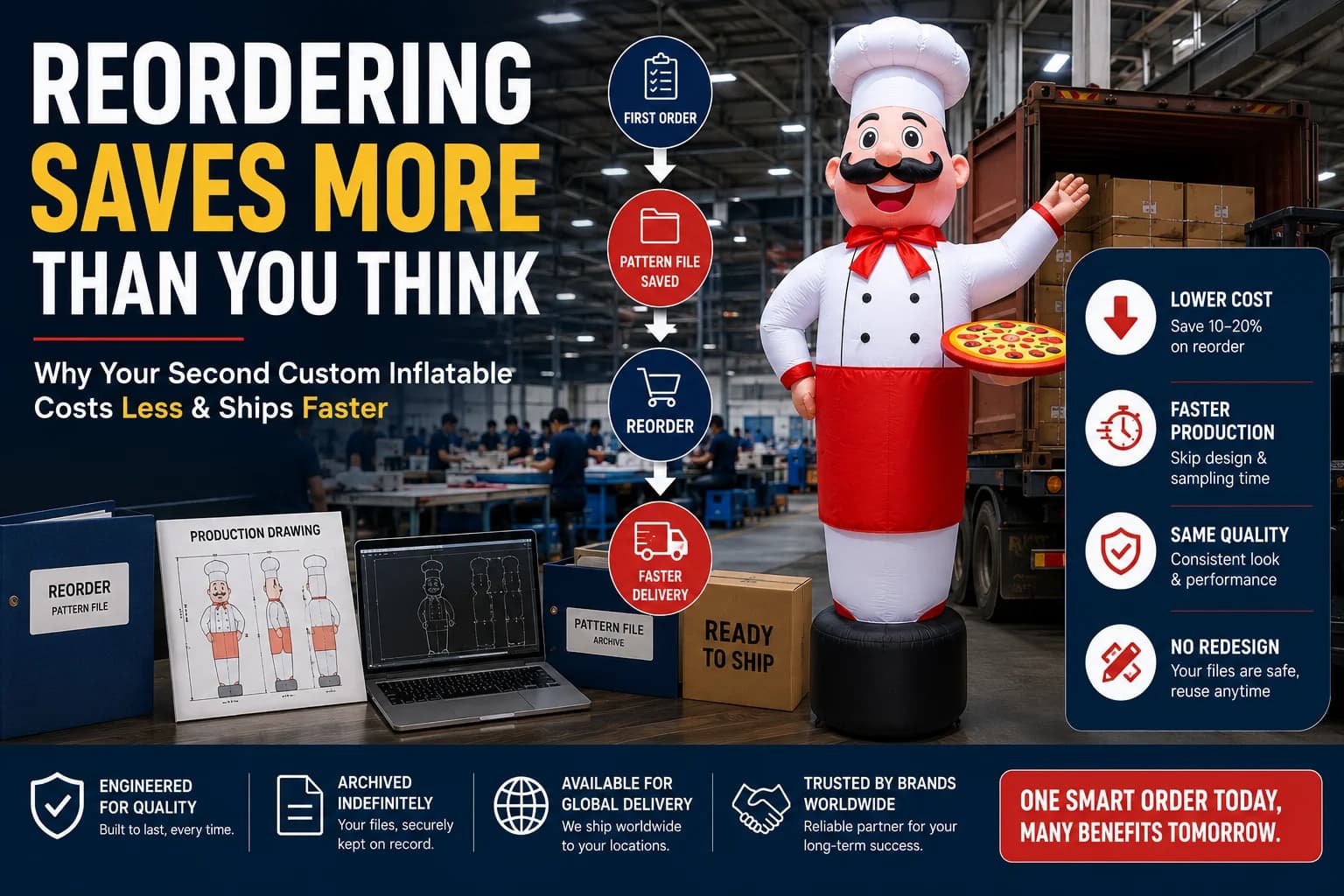
What You Actually Bought the First Time
Your first custom order's price covered more than fabric and labor. It funded:
- 3D modeling of your design into production patterns
- Panel nesting files — the exact cutting geometry for every fabric piece
- Color profiles — your Pantone references translated into printer-specific ink settings
- The sampling loop — mockup rounds, revisions, your approvals
- Process notes — which seams needed reinforcement, where the blower ports sit, what the QC checklist flagged
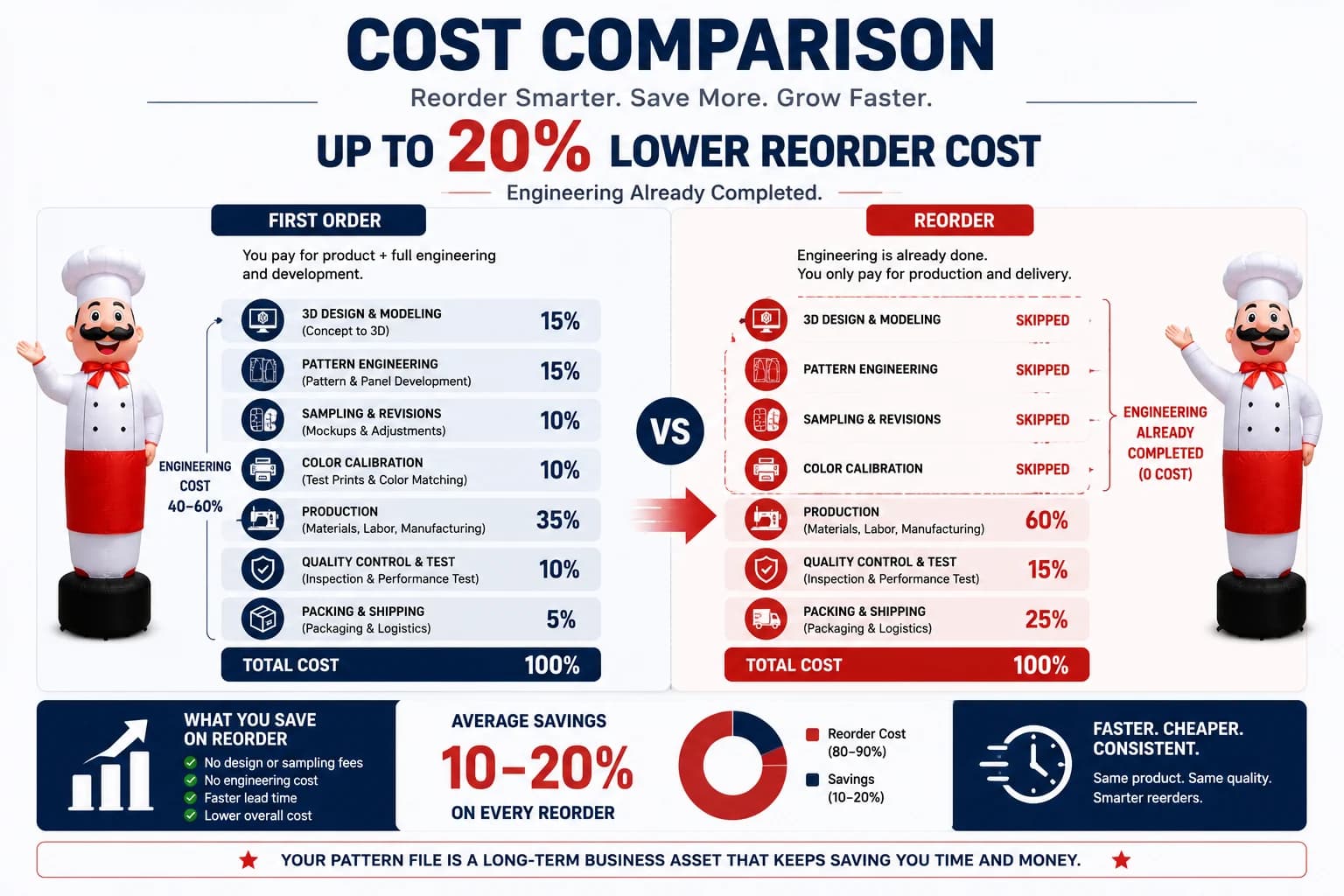
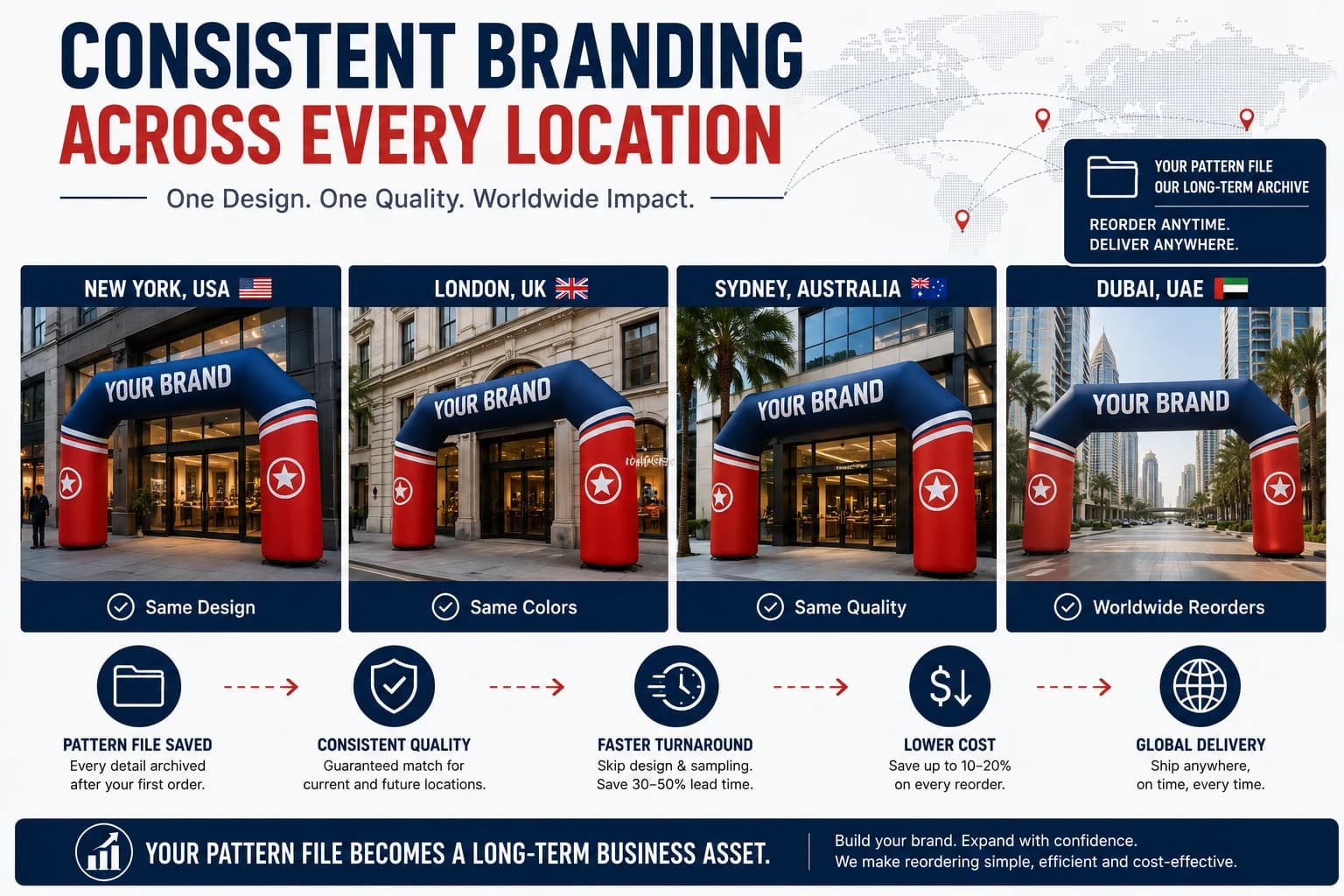
On a typical project, this engineering layer is 20–35% of the first order's cost and 30–50% of its calendar time. When we keep your files on record — and we keep them indefinitely — none of it needs to happen twice.
The Second-Order Math
What changes when you reorder the same item:
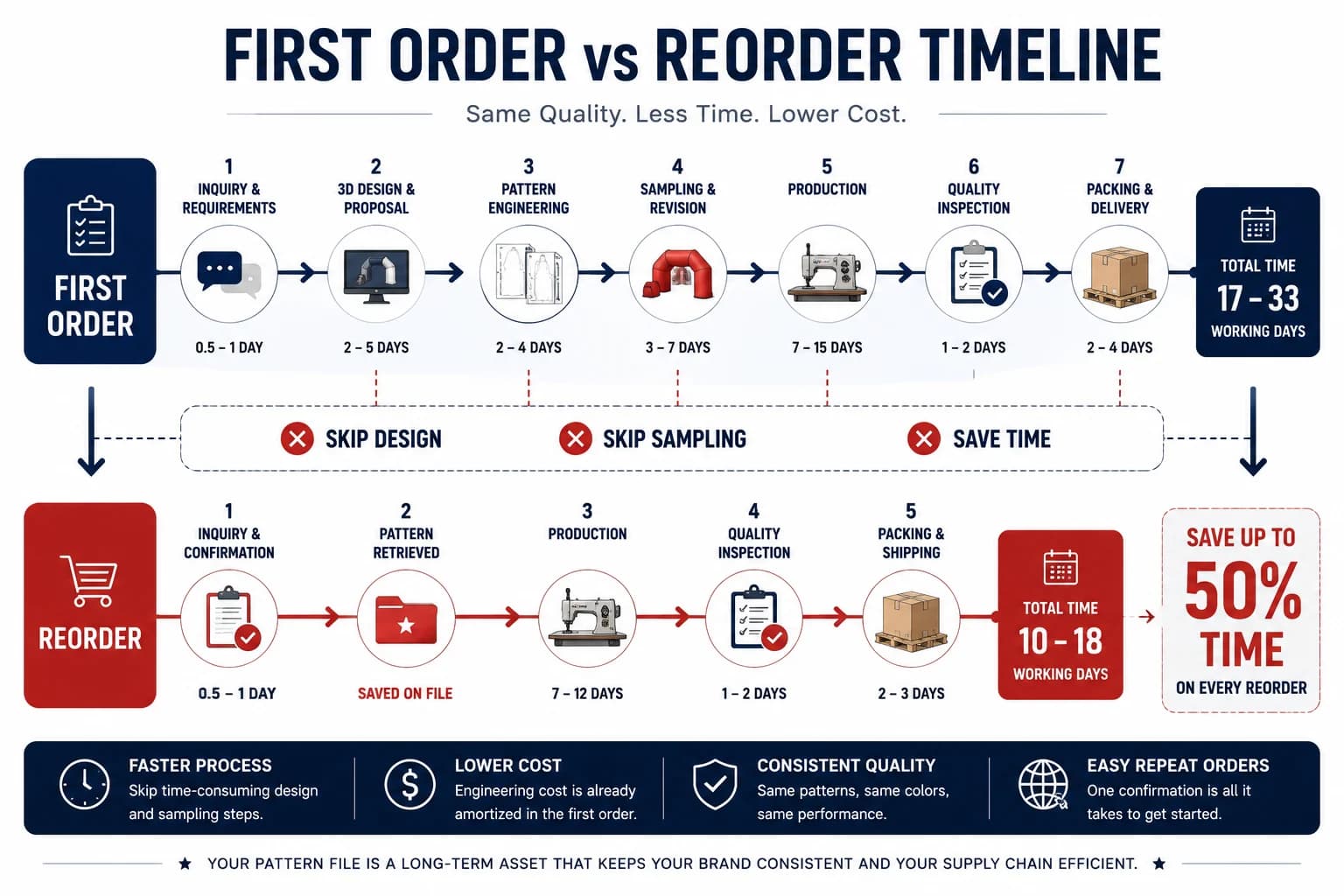
| Stage | First Order | Reorder |
|---|---|---|
| 3D modeling & mockup rounds | 2–5 days | Skipped |
| Pattern engineering | Included in production | Already on file |
| Color calibration | Test prints | Stored profile |
| Production | 7–15 working days | 7–12 working days |
| Your internal approvals | Days of back-and-forth | One confirmation message |
The invoice reflects it too: with engineering amortized, reorders typically land 10–20% below first-order pricing at the same quantity, before any volume discount. Quote-to-payment on the Australian reorder above took three days — most of which was the client's own team confirming quantities.
Consistency Is the Hidden Product
For chains and franchises, the pattern file is not about saving money — it is about the ninth store's inflatable matching the first store's. Fabric batches vary, printers drift, staff change. The stored cutting pattern and color profile are what guarantee that a unit produced in 2027 sits next to a 2026 unit without a visible seam between “generations.” A client's brand book stays enforced by manufacturing infrastructure rather than by hope.
The same logic protects you across personnel change — on both sides. The Australian client's original contact had moved on; the reorder still referenced “the products Reid handled” and the archive answered. Your order history is institutional memory that survives salespeople, marketing managers and agencies.
Small Variations Ride the Same Rails
Reorders rarely mean identical. The real request is usually “same, but —”: same banner, longer size; same mascot, new sponsor patch; same arch, updated year. Variations that keep the structural pattern intact — size scaling within limits, print-layer changes, color swaps — reuse most of the engineering and stay close to reorder pricing. Only geometry changes (new shape, new proportions) send a project back through modeling.
A practical tip from how experienced clients order: when your first order performs well, ask us to note the exact configuration in your file — including things you improvised on site, like extra ballast or a shorter tether. The reorder then encodes the field-tested setup, not just the factory spec.
How to Make Your First Order Reorder-Ready
- Buy the pattern quality, not just the product. A supplier who engineers properly the first time makes every future unit cheaper.
- Confirm your files are kept on record — and that they are yours to reorder against. We hold patterns indefinitely; not everyone does.
- Keep one reference document on your side: product names, dimensions, order dates. One sentence — “reorder PO-2026-041, quantity 10” — is a complete brief.
- Photograph your deployments. Field photos attached to your file make support and variation requests faster.
Frequently Asked Questions
How long do you keep our patterns and print files?
Indefinitely. Clients have reordered against three-year-old files with no re-engineering.
Is there a minimum quantity for a reorder?
No — reorder MOQ is 1 piece, same as first orders. Single-unit replacements for damaged items are common.
Our brand colors changed slightly — is that a new project?
No. Color swaps on an existing pattern are a print-layer change: we update the profile against your new Pantone references and production proceeds on reorder timelines.
Can a different vendor produce from your pattern files?
Pattern files encode our machine and process parameters, so they are not portable in practice. What is portable is your design artwork — which was always yours.
Do reorders get a discount automatically?
Reorder pricing reflects the skipped engineering automatically; volume discounts stack on top from 5 units. Ask for the combined quote when ordering for multiple locations.
Related Resources
- How We Reproduce Your Brand Colors — the color-profile system behind consistent reorders
- Giant Custom Inflatables — the product line most multi-location brands reorder
- Case Study: LED Inflatable Delivered DDP to Italy — a two-line all-inclusive quote in practice
Ready to Reorder — or Start Your First Pattern?
Reordering starts with one message: product name, quantity and destination. First order? We'll engineer it so future repeat units are easier to quote, approve and reproduce.
Get My Quote