Inflatable Arch Size: Inner Clear Opening vs Outer Dimensions
This inflatable archway guide starts with two measurements: the usable clear opening and the overall inflated size. Provide the required passage width and height first, then confirm the outside dimensions and setup space on the project drawing before requesting a quote.
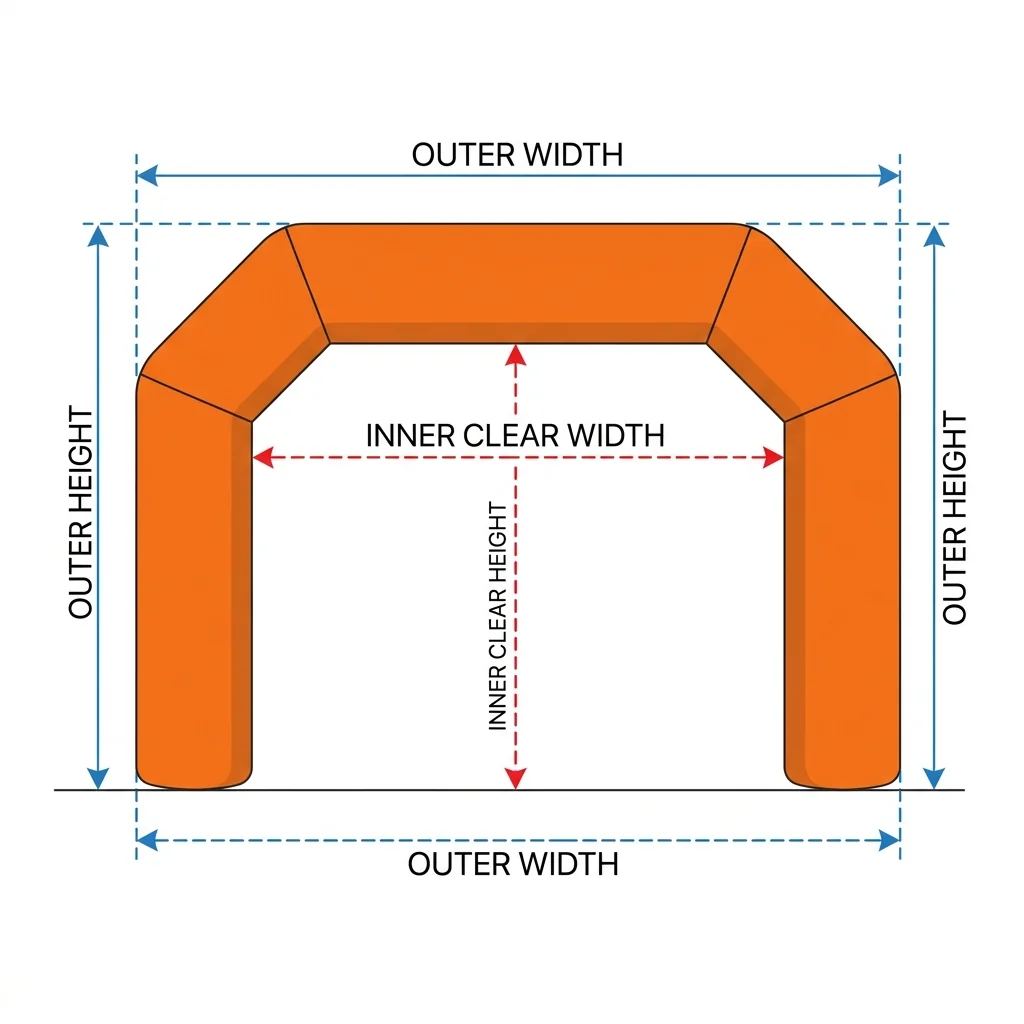
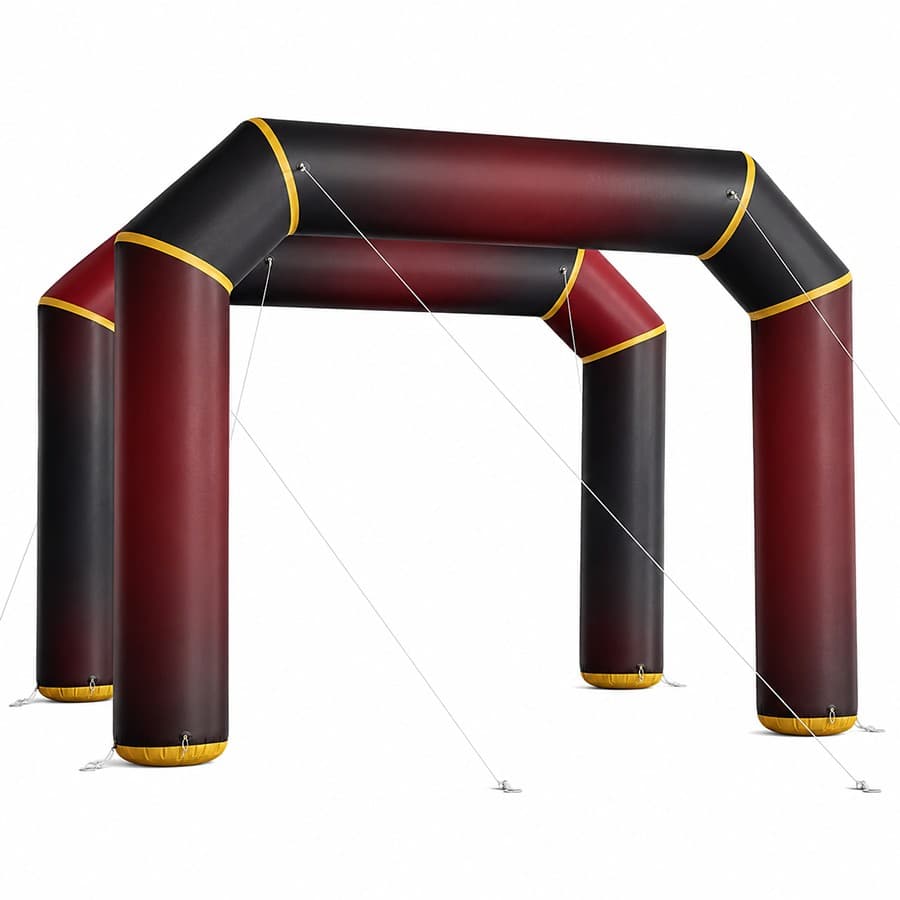
If you've ever requested a quote for a custom inflatable arch and received a 3D mockup that looked nothing like what you expected, there's a good chance the issue wasn't the design — it was the measurements. Specifically, the difference between inner dimensions (the usable clear space people or vehicles pass through) and outer dimensions (the full structural footprint of the inflatable). Clarifying both measurements early can reduce unnecessary revisions before a quote is approved.
Why This Mistake Happens So Often
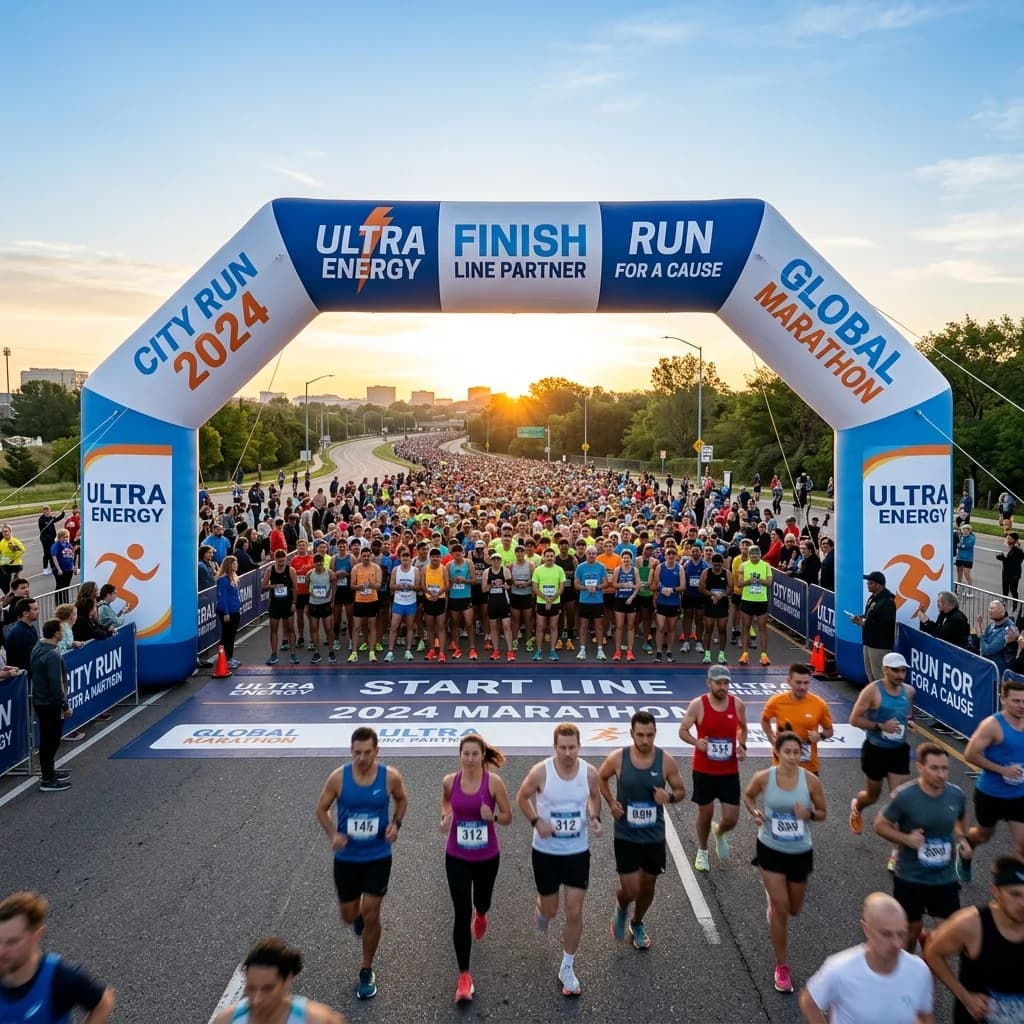
When a race director, event planner, or marketing manager requests "a 4-metre arch," that figure may refer to either clear opening or overall size — the width and height that runners, cyclists, or pedestrians will actually pass through. But many first-time buyers don't realize that the inflatable structure itself (the legs, the top crossbar, the printed surface) adds additional dimension on top of that clear space.
Inner Dimensions: What Actually Matters for Function
Inner dimensions refer to the usable space inside the arch:
- Clear width — the horizontal space available for people, banners, or vehicles to pass through
- Clear height — the vertical clearance from the ground to the underside of the top crossbar
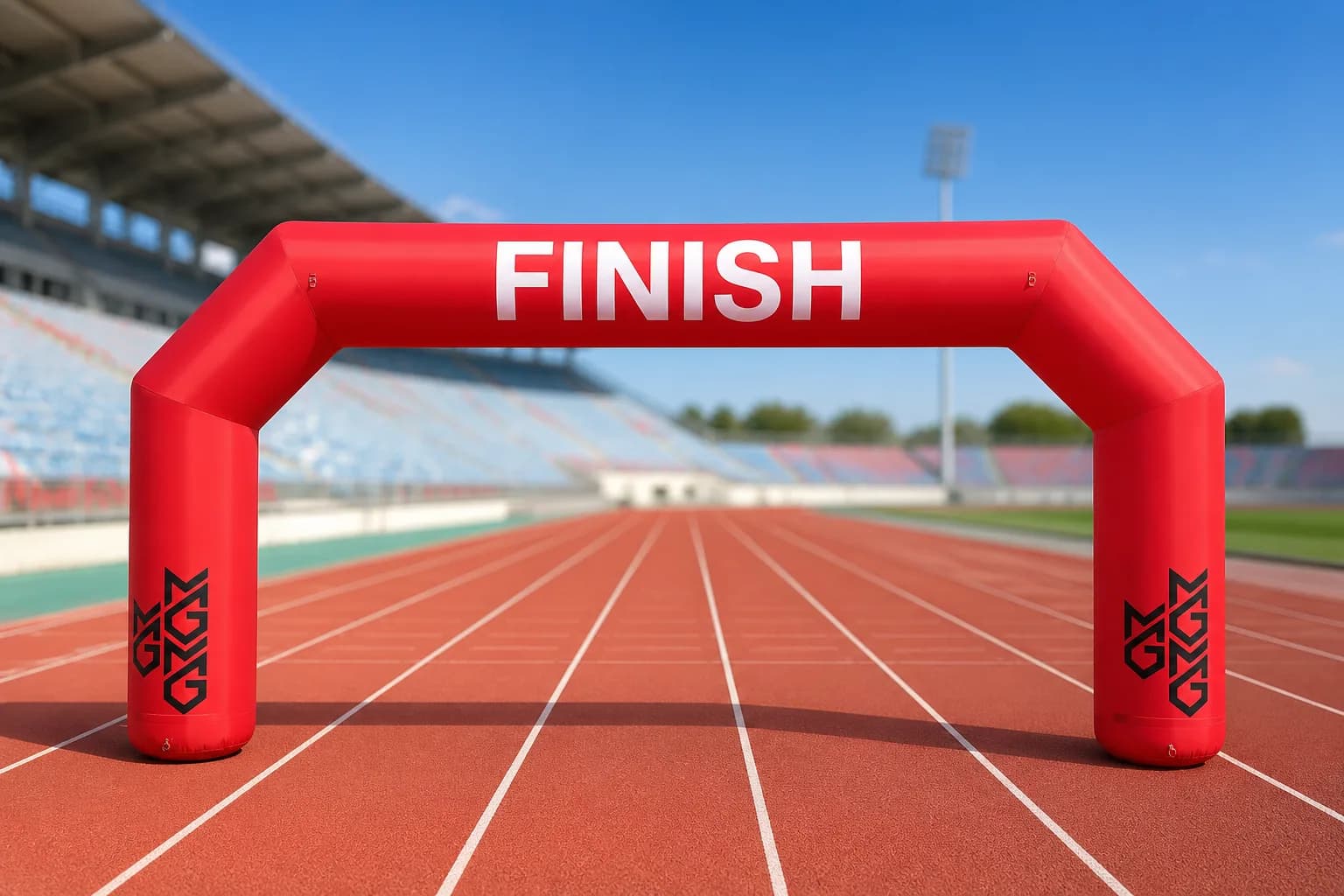
For marathon and race organizers, clear height is often the critical safety dimension — it must comfortably clear the tallest expected participant, any raised arms during celebration, and any timing equipment mounted above the passage.
Outer Dimensions: What Determines the Physical Footprint
Outer dimensions describe the total structural size of the inflatable, including:
- The proposed leg or column thickness, confirmed from the build drawings
- The depth of the top crossbar structure
- Any decorative elements extending beyond the core frame
Archway Measurement Checklist for Buyers
There is no universal arch opening suitable for every race or exhibition. Agree the usable passage with the event organizer, timing provider and venue first; ask the supplier to show the resulting overall dimensions on a scaled drawing.
| Project use | Measurement to provide | Approval to request |
|---|---|---|
| Marathon or group finish | Chute width, flow direction, timing equipment and required clear height | Inner opening on a drawing, outside footprint and organizer-approved passage |
| Single-file race or foot traffic | Actual route width, participant needs and surrounding public access | Clear opening plus safe separation from structure and anchoring |
| Vehicle or service access | Vehicle envelope, turning route and a venue-approved safety margin | Site-specific clearance and permitted crossing plan |
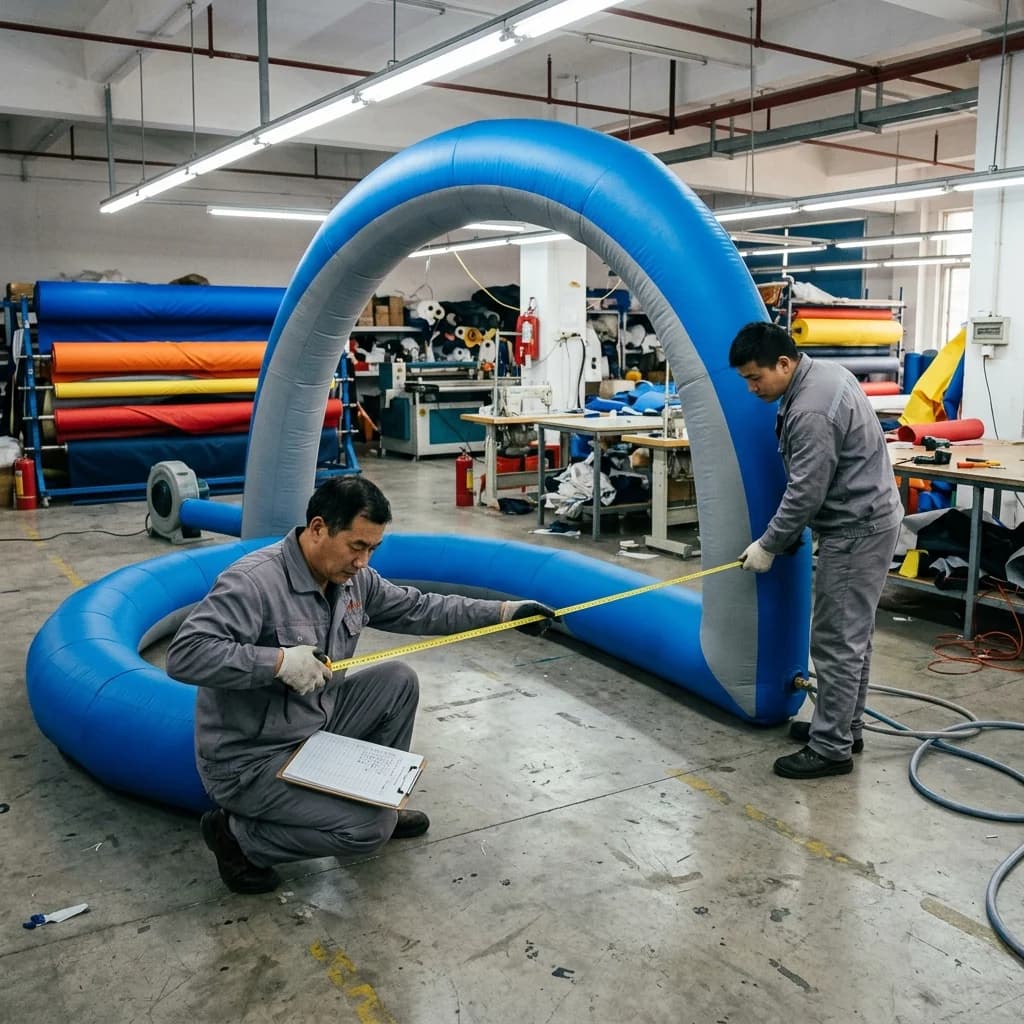
Sketch the Two Dimensions Before Quoting
What to Send With Your Arch RFQ
- Required inner clear width and height, venue route plan and intended user flow
- Available outer footprint, overhead clearance, ground type and safe access space
- Logo or sponsor artwork, viewing direction and camera placement
- Outdoor wind exposure, power supply, installation team and venue rules
- Quantity, event date, destination and preferred delivery terms
Compare a custom marathon arch with the arch and tunnel category. Request a project drawing before confirming fabrication.
How to Communicate Your Requirement Correctly
The most reliable way to avoid this confusion entirely is to specify both numbers when requesting a quote: "The event operator requires a 4m clear opening in both directions. Please review the outside dimensions, column sizing, anchor footprint and installation restrictions for our site." This is a *request for review*, not proof that a 4m opening is suitable for every venue.
B2B procurement expansion · 16 October 2026
Inflatable Archway Approval: From Clear Opening to a Quote-Ready Drawing
A requested “six-metre arch” is not an adequate manufacturing specification. Agree the usable opening, full installed envelope, sponsor-facing surfaces and operating assumptions on the same version-controlled drawing.
This expanded checklist is for event production agencies, race directors, exhibition contractors and importers in the United States, Canada, Europe and Australia. It helps buyers compare custom arch quotations, not approve the structural safety of an installation. The venue or event operator must determine passage, anchoring, accessibility, weather and emergency access requirements for the specific site.
1. Specify the passage before choosing an overall arch size
Begin with a plan of the actual route. Mark the narrowest usable passage, finish timing equipment, queue barriers, camera position and whether people, bicycles, wheeled equipment or vehicles pass underneath. For each relevant opening, request clear width between the inside faces and clear height below the lowest overhead portion. On a curved arch, the clearance at the edges can be less than the height at the centre; a single centre-height figure may conceal that restriction.
Only after those clearances are agreed should the supplier propose an outer width, outer height, column thickness and front-to-back depth. Include bases, projecting graphics and any other physical extensions in the drawing. Column thickness and outer span affect materials, appearance and the position of branding; do not assume two designs offering the same walkway clearance will be identical in cost or appearance.
Use a dimensioned plan and front elevation for the quotation. A marketing mockup on a photograph helps with visual alignment but is not a substitute for the measured view. Avoid copying a competitor’s published model dimensions into your brief as if they were standard dimensions for an InflatCustom product.
2. Include installation space outside the printed structure
The occupied space may extend beyond the air-filled legs. Ask the venue and installation team to mark positions for anchoring, any guy lines or ballast, blower and protected cable routes, staging access, fencing and pedestrian diversion. The final plan also needs the separation from spectator areas, accessible routes, evacuation paths and permanent site features. There is no universal one-metre or two-metre allowance that makes every arch safe.
For outdoor start and finish zones, clarify the surface and whether penetrative fixings are permitted. Paving, turf, indoor floors and raised platforms impose different practical constraints. Include an operating owner who can monitor the installed structure and follow the venue’s weather or shutdown plan. For an indoor exhibition, check hall height, rigging prohibitions, power distribution, loading access and show rules rather than assuming outdoors-only anchoring guidance applies.
If a festival or race agency needs the arch to travel across venues, request a location-by-location review. Equipment or permission appropriate to one venue must not be treated as automatically adequate at another. The manufacturer can discuss the construction and accessory scope; the local event operator retains site-specific responsibilities.
3. Approve sponsor panels as part of the structure, not after it
Brand managers should identify the primary camera approach, participant travel direction, photo backdrop and sponsor hierarchy. Reserve the highest-visibility printable areas on the top beam and legs, while checking that artwork does not cross access openings, seams, reinforcement or highly curved surfaces. A prominent wordmark on a flat artwork sheet may become difficult to read on a rounded inflated tube.
When sponsors may change between race editions, ask whether removable panels, covers or a revised print skin can be considered for that particular build. Do not assume every construction supports interchangeable graphics. Record which artwork faces are included, whether double-sided printing is expected, how colour references will be approved and who holds trademark authorization.
Request a numbered proof with front and reverse elevations and at least one visitor-facing perspective. A revised date or sponsor logo can alter lead time and scope after approval; it should trigger an explicit drawing revision, not an informal chat instruction.
4. Compare inflation, power and handover assumptions
A continuously powered arch and a sealed-air design impose different operating and accessory considerations. Ask what inflation method can actually be quoted for the requested span, profile, venue and display period. If the design uses a continuous blower, request its electrical and placement requirements for the destination and plan safe cable routing. A sealed-air concept should still be reviewed for pressure maintenance, inspection and the proposed operating period; “no permanent blower” does not equal “no site management.”
Confirm who supplies and checks anchors or ballast, who supervises installation, whether any lighting is included, and who stores and re-packs the arch. Agree what evidence is available before dispatch: approved drawings, a test-inflation photo or video if offered for the project, the accessory inventory and the packed size. Ask about project-relevant material or electrical records only when these are actually available. No generic mention of a standard should be interpreted as certification for a finished arch or permission to install it at your venue.
5. Use one approval matrix for all supplier quotations
Request each supplier to respond to the same drawing revision. A headline size or unit price alone may conceal different clear openings, printed coverage, logistics terms and installation exclusions.
| Approval item | Evidence requested | Quotation consequence |
|---|---|---|
| Clear opening | Inside width, minimum height along passage; site drawing | Determines whether the concept fits its intended traffic |
| Overall envelope | Outer width, height, depth, column and base positions | Affects structural layout, material and packing scope |
| Sponsors | Proof revision, readable faces, permissions and print zones | Defines artwork effort, coverage and reprint changes |
| Operation | Indoor/outdoor site, power, surface, local install team and weather plan | Clarifies feasible configuration and site responsibilities |
| Delivery | Quantity, event date, destination, trade term, packing and accessories | Separates manufacturing, freight and local services |
| Sign-off | Approved drawing revision, exclusions and agreed pre-dispatch evidence | Makes supplier bids and acceptance checks comparable |
6. Example of a useful initial RFQ
Request: Custom inflatable finish-line arch for a sponsor-branded running event. Site: [city, country, route diagram, surface and hall or outdoor use]. Opening: Our timing and venue team requires [X] m clear width and [Y] m minimum clear height at the passage. Size limit: Please propose an outer envelope that fits [available area]. Graphics: Front, rear and side brand placement drawings plus editable logos; main camera approach indicated. Operations: [power, local crew, expected hours, venue installation conditions]. Quantity and schedule: [number, event date and required arrival date]. Commercial: Quote the proposed inflation setup, printing, accessories, packing, trade term, available project documents and exclusions. Please provide a dimensioned proof for approval before final pricing.
This is a template, not a sample order or a promise that a particular size will be approved. At first contact, an approximate route sketch, desired clear opening, logo, destination and deadline are sufficient to start discussing feasibility. Final sign-off requires venue and project details.
Related decisions and source context
For event-specific participant flow, continue to the race finish-line clearance guide. For installation risk, see the wind and anchoring checklist and compare available configurations in Inflatable Event Tunnels & Arches. Those pages serve different decisions: route traffic, installation planning and product selection respectively.
Reference reading (accessed 16 October 2026; publication dates not stated on the accessed pages): the UK Health and Safety Executive’s temporary-structures guidance provides general event-site safety context; AxionUK’s publicly listed inner and outer model dimensions illustrate why the two measurements differ. Neither source is InflatCustom product data, a case study, a venue approval or a certification.
Request a project-specific review
Send the route drawing, target opening, branding files, location and event deadline.
Frequently Asked Questions
Which measurement should I give first when requesting a quote — inner or outer?
Provide the required usable passage width and height first, then confirm the total outside width and height. The outer footprint, base, anchoring and clearance must be checked against the proposed build and venue plan.
Does a larger outer footprint cost more even if inner clearance is the same?
The quote can change with outside dimensions, fabric and print area, shape complexity, column design, accessories, anchoring and packing. Ask suppliers to compare the same approved clear opening and full build scope.
How much ground space should I plan for beyond the arch itself?
There is no universal side-clearance allowance. Ask the venue operator and installation team to confirm safe access, anchoring positions, ballast, guy lines, pedestrian routes and emergency clearances for the actual site.
Can I request a custom leg diameter to reduce the outer footprint?
You can request a narrower overall footprint for review, but column proportions and reinforcement must be assessed for the proposed construction, inflation system and site. Do not assume a visual mockup approves an installation.
Ready for an Arch Design Review?
Send your logo and clear inner dimensions so the design direction and practical configuration can be reviewed for the project.
Get Project Quote