Giant Inflatable Santa Size Guide: Comparing 4 m, 6 m and 8 m Displays
Published
Quick buyer answer
Choose the smallest giant inflatable Santa that meets your main viewing and photography goals within an approved installation area. A 4 m concept is a useful starting point for a closer-view display; 6 m deserves comparison when Santa needs more presence across a larger space; 8 m is a landmark-scale option that needs a convincing site plan. These are planning directions, not automatic venue matches.
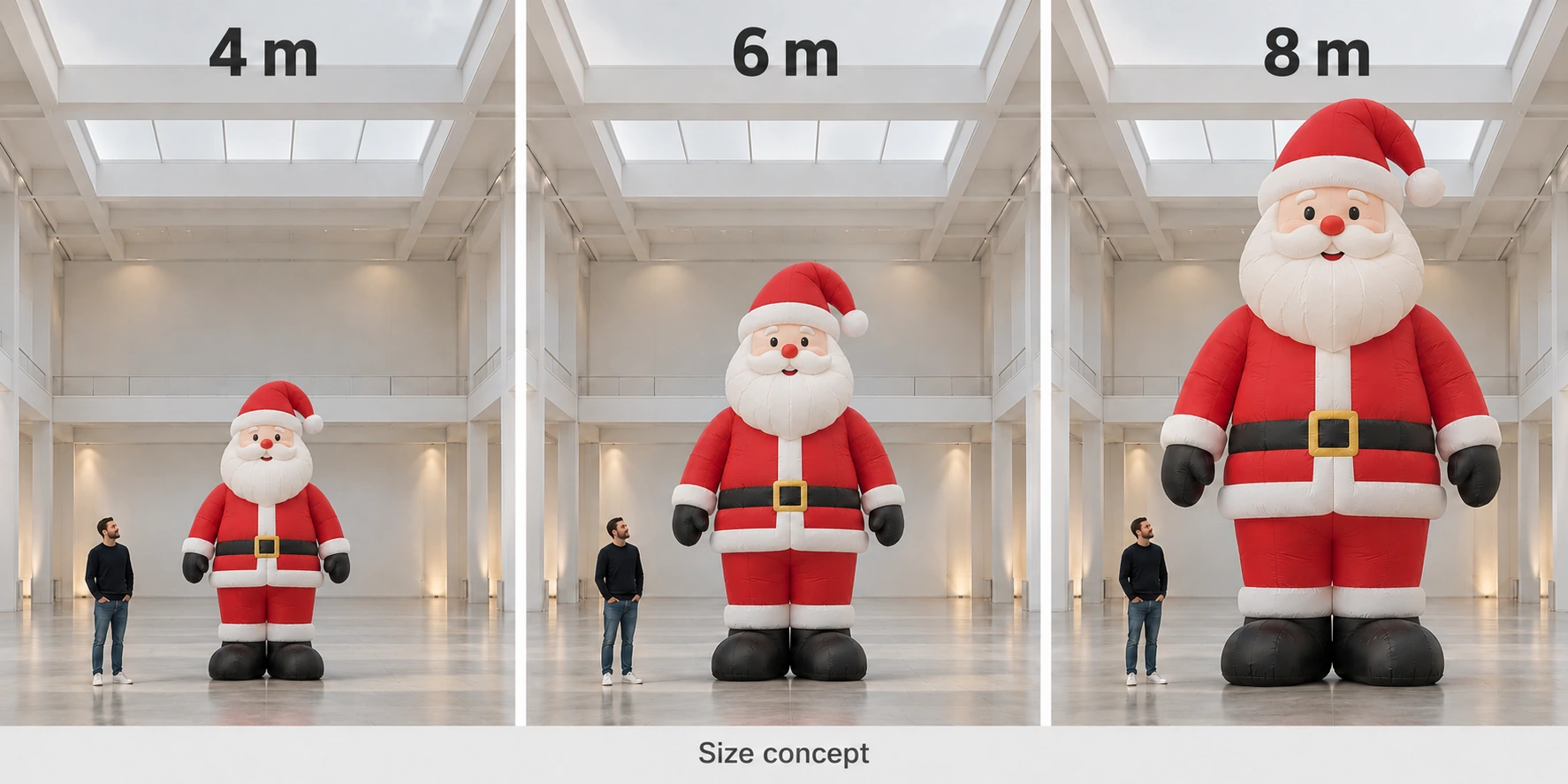
InflatCustom's Large Festive Inflatable Santa Claus lists custom heights from 1–8 m. The three heights below are comparison points within that range. Width, depth, equipment and installation requirements must be confirmed for the chosen design.
Start with the view that must work
“Make it impressive” is difficult to price and approve. Give the display one primary job: attracting attention from an approach route, anchoring an atrium composition, or appearing in photographs with visitors. Each job produces a different size decision.
For an approach-route landmark, identify the first point where visitors should recognize Santa. Photograph that view with existing trees, signs, canopies and seasonal decorations in place. A taller character can still disappear behind a canopy or become visually crowded against a busy façade.
For a photo setting, mark the likely camera position and the visitor position. Test whether the whole character, a person's face and the intended branding can share the frame. If visitors cannot step back, increasing height may make full-character photographs harder. A good 4 m composition can serve that objective better than an 8 m character whose face falls outside the image.
For an atrium, include views from upper floors. Santa's hat and shoulders may be prominent from a balcony while the face is hidden. Ask for these viewpoints in the mockup rather than approving only an eye-level front view.
Compare 4 m, 6 m and 8 m against the same brief
| Comparison point | 4 m concept | 6 m concept | 8 m concept |
|---|---|---|---|
| Visual role to test | Closer-view focal point | Stronger presence across a larger space | Landmark visible within a broad composition |
| Photography question | Can visitors and the complete figure fit together? | Is there enough camera setback for the intended frame? | Is the target image a wide establishing shot or a close visitor photo? |
| Fit question | Does the full character leave the required circulation space? | Do the arms, sack and body depth fit the approved area? | Can the venue accept the whole display and its operating arrangement? |
| Approval priority | Actual width and depth | Clearances and overlapping sightlines | Venue feasibility before committing to detailed design |
| Reason to choose it | It already achieves the viewing goal | A site mockup shows a meaningful visual improvement | The landmark effect justifies the project-specific installation scope |
Keep the pose, colors and viewing position consistent when comparing mockups. Otherwise, a smiling 4 m Santa with raised arms and an 8 m Santa holding a sack are testing two design choices at once.
Height is only one dimension
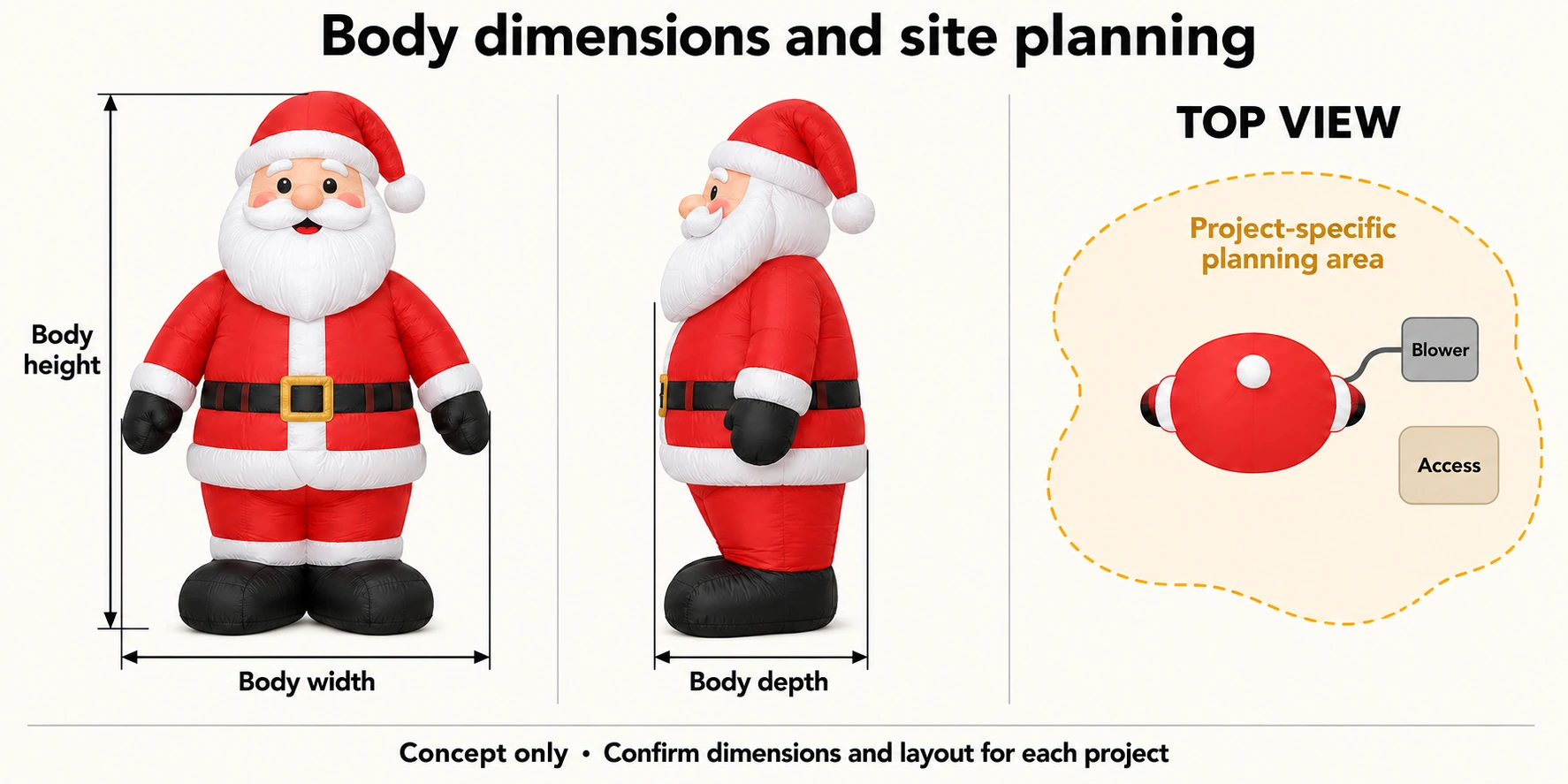
A Santa's widest point may be its elbows, sack or outstretched hand. Its deepest point may sit behind the body. A height-only quotation leaves those details unresolved.
Request a dimensioned front view and side view showing the maximum body envelope. Establish where height is measured from and whether a base or decorative platform is included. Ask the supplier to distinguish the inflatable's dimensions from the space required for equipment, securing arrangements, access and management.
A simple geometry example explains why size deserves careful review: if every dimension of the same shape doubled, its projected area would become four times as large. This is an illustration of proportional scaling, not a forecast of the actual footprint, weight, wind loading, blower requirement or price of an 8 m Santa. Real designs and their support arrangements must be assessed individually.
Avoid using a single scaling factor to estimate the order total. Ask for separate quotations against the same agreed scope.
Check the site before approving the upgrade
Use one marked-up site plan for all shortlisted heights. It should distinguish the approved display area from visitor routes and building services. Record the actual restrictions supplied by the venue, rather than adding a generic safety distance copied from another project.
Work through these checks with the venue and installation team:
- Maximum permitted display height, including any base or platform
- Obstructions above and around the character, including signs and existing decorations
- Access routes, doors, lifts and handling restrictions for packed goods and equipment
- The proposed operating and equipment locations, with cable routing to be reviewed
- Areas needed for installation, inspection and eventual removal
- Indoor or outdoor exposure and the responsible person's operating plan
- Any required documentation, review appointments and approval deadlines
For an outdoor location, size selection must be part of a project-specific securing and weather plan. Do not assume that choosing the smaller option removes that obligation. The responsible specialists must determine suitable arrangements and operating limits for the actual site and product.
Make the size comparison commercially useful
Ask the supplier to keep the comparison like-for-like: same character, pose, artwork, quantity, intended environment and lighting requirement. Then request the dimensions, equipment, packing and exclusions for each alternative.
An apparent price difference becomes more useful when the team can see which local services it may change. Ask the installer whether each option changes access needs, setup arrangements, crew planning or storage handling. Record venue charges separately from the factory's supply scope.
Consider the next likely venue too. If a touring display must work in several locations, test each proposed size against the most restrictive confirmed site. Buying the largest version for the launch venue can limit later reuse. Where future sites are unknown, record that uncertainty instead of treating portability as proven.
A practical shortlist usually contains two sizes. Keep both under review until the site mockup and installation feedback reveal whether the larger version solves a real visibility problem.
Request a size comparison with a clear brief
Review the custom Santa display, then request a quotation naming the two or three heights you want compared.
The contact form starts with your name, business email, product type and destination country. Use its optional size, timing and project-description fields to explain the display's job, available area and installation date. Describe the site photographs and plan you can provide; the contact page also offers a WhatsApp route for files. Ask for a like-for-like size comparison with dimensions and supply scope before selecting the final height.
Quick buyer checklist
Related product options
Frequently asked questions
Is a 4 m Santa too small for a shopping mall?
There is no universal mall size. A 4 m concept can be worth testing for a close-view composition, while an open atrium may call for a different scale. Use photographs from the actual viewing points and a dimensioned mockup before deciding.
Does an 8 m Santa need twice the floor space of a 4 m Santa?
Height alone cannot establish floor-space needs. Width and depth depend on the pose and proportions, while equipment and securing arrangements require separate review. Obtain the complete dimensions and installation layout for both designs.
Can we keep the same design across several heights?
Request that explicitly, then review each size. Features such as the eyes, beard, gloves and logo placement may need interpretation to remain visually consistent. One approved image should not automatically authorize every size variant.
Should we choose the tallest option that fits below the ceiling?
No. Ceiling fit is only one test. Check sightlines, venue restrictions, visitor routes, equipment, photography and installation access. A smaller character may create a more complete and usable display composition.
Can a late-season order still arrive before Christmas?
Availability must be checked against your required installation date, approvals, production scope and destination. A published size range does not establish delivery availability. Request a current project schedule before making commitments to the venue or campaign team.
Request a project-specific comparison
Choose Santa's height around the view that matters. Compare 4 m, 6 m and 8 m concepts without mistaking height for footprint or installation feasibility.
Send Quote Request