B2B Technical Buying Guide · Published 17 October 2026 · Updated 25 October 2026
Custom Inflatable Structures & Sculptures: A B2B Buying Guide
For brand owners, event agencies, exhibition contractors and distributors specifying giant 3D promotional inflatables for real venues.
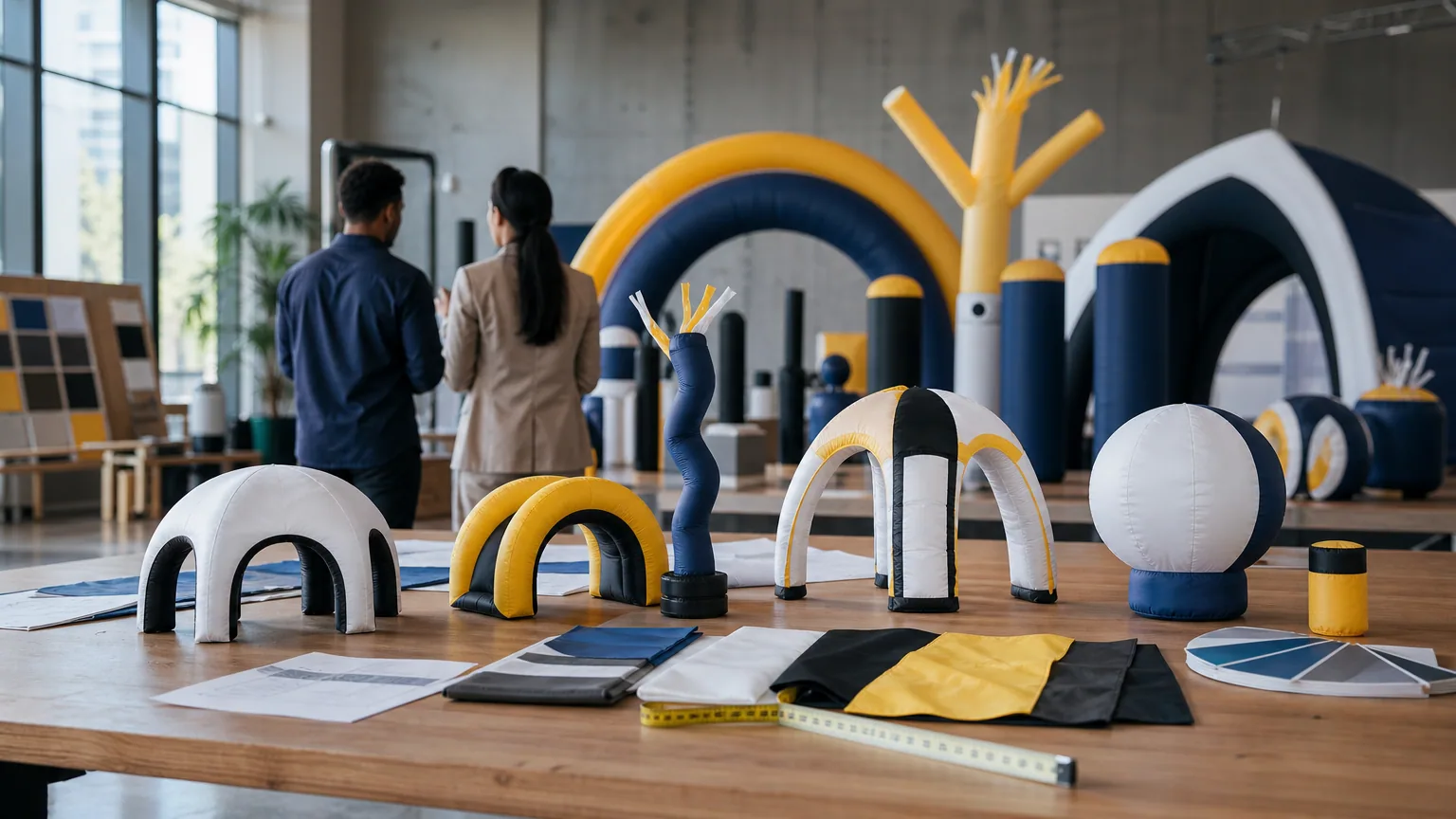
Which custom 3D inflatable should you buy?
Choose a custom inflatable sculpture when you need a recognizable decorative 3D object or a branded photo opportunity. Choose a giant product replica when a bottle, can or package silhouette is the campaign message. Choose an inflatable arch or tunnel when an event needs a defined entrance with a usable passage. Choose inflatable letters or a shaped logo when the audience must read a name. These are different purchasing jobs even though all may be described as custom inflatable structures.
The most useful first question is not “How big can it be?” but “What must visitors recognize, and from where?” A promotional sculpture may need detailed front and side views; a product replica needs accurate packaging proportions; a sponsor arch needs a safe and clearly specified passage. A concept render is a useful starting point, not proof that the product is ready for manufacture or venue approval. Review custom shaped inflatables for the main commercial selection route.
Compare the four main inflatable display formats
Separate the job the display must perform from the features you want the supplier to confirm. A generic quote for a “giant custom inflatable” is not comparable if one buyer needs a walk-through entrance and another needs a freestanding brand object.
| Format | Best campaign job | Buyer approval points |
|---|---|---|
| Freestanding inflatable sculpture | Decorative 3D character, flower or brand photo moment | Front/side silhouette, base, footprint, printed detail |
| Giant product replica | Make a bottle, can or package the focus of a launch | Reference proportions, curved label artwork, main viewing side |
| Arch or event tunnel | Define an entrance, sponsor zone or race route | Outside dimensions, usable clear opening, crowd flow and anchoring |
| Inflatable letters or logo | Display a readable name, number or brand mark | Vector artwork, overall word width, viewing distance and lighting |
The comparison also explains why a custom inflatable mascot, shaped logo sign and sculptural installation should not be marketed as identical products. Buyers need different approval drawings, accessories and site information for each format.
Approve the shape from several viewing angles
A giant custom inflatable may look convincing in a front-facing mockup but appear too narrow from the side or hide important details after inflation. Mark the audience approach, primary photograph angle and brand-facing side. Request front, side and rear views with a scale reference, an approximate base footprint and a note about seams or reinforcements that may change the visible outline.
For a sculptural character, review facial proportions, silhouette, projecting parts and the base. For a beverage or food replica, compare product proportions, printed label curvature and where graphics cross a seam. For an arch or tunnel, compare the clear inside passage with the outside size. Identify which brand details must remain exact and which can be adapted for practical construction.
When protected artwork, a mascot character or a branded product is involved, confirm who has authority to approve its use. The 3D mockup approval guide can help buyers turn reference images into a written design-review process. A mockup should support the decision; it should not be presented as a photograph of an actual delivery.
Venue clearance and inflation are part of the specification
Before selecting the height of a custom inflatable structure, record venue door access, ceiling clearance, available width and depth, ground conditions and the distance to public walkways. Ask whether the display is freestanding, suspended, decorative or walk-through. A decorative inflatable sculpture must not be assumed to support people, equipment or building loads. For an entrance arch, record the usable opening independently from the nominal outer dimensions.
A continuously powered shape requires a suitable blower, power supply, cable route, operating space and a plan for supervision. A sealed-air concept raises different questions about pressure retention, valves and maintenance. Neither inflation method is universally preferable. Ask the supplier to explain the proposed system for the actual shape, display duration and site restrictions rather than selecting from a generic claim.
Outdoor suitability depends on the design, wind exposure, anchoring plan, surface, local rules and responsible installation team. Do not infer a universal wind rating, fire classification or safety certification from a material name or a website badge. Ask which documents apply to the quoted construction and who will obtain any venue permits or local approvals.
Ground-standing or suspended? Define the actual installation before ordering
A 3D inflatable quoted for floor display is not automatically suitable for ceiling suspension. Both may reproduce the same artwork, but the scope changes when installed weight, lift points, venue rigging, audience clearance or electrical routing is involved. Tell the supplier how the finished item will be displayed, not simply that it will be used at a trade show.
| Display plan | What the buyer should provide | What must be reviewed |
|---|---|---|
| Ground-standing sculpture or product replica | Available floor area, audience approaches, base location, surface and power | Stability, ballast/anchor scope, public separation, cable management and outdoor restrictions |
| Overhead or ceiling-suspended display | Exhibitor manual, booth plan, proposed hanging position, clearance and appointed rigger | Approved rigging method, exact installed weight, suspension points, power and organizer permission |
| Booth-frame integrated sculpture | Stand drawings, connection interface and build contractor details | Independent support design, permitted loads, access and installation responsibility |
| Walk-through arch or tunnel | Clear opening, route/crowd plan, outside footprint and operating conditions | Usable clearance, evacuation routes, ground fixings, supervision and venue sign-off |
The distinction matters for agencies reusing an inflatable across venues. A display approved for one booth or mall atrium is not automatically authorized at another venue. Ask for an installation-specific review whenever mounting, ceiling access, public pathways or wind exposure changes.
The event-venue approval pack: six documents to clarify before the RFQ
Trade-show organizers may require more than a product photograph. For example, the 2026 ASTRO Annual Meeting exhibitor policy requires renderings showing size and exact booth placement for exhibits needing rigging. A GES event rigging policy example requests a line drawing and top-view booth layout for hanging-sign or truss review. These are examples from particular events, not universal rules or proof of product approval. The buyer must obtain the current manual and approval for the actual event.
- Venue and exhibitor identification: event name, hall, stand number, installation dates, appointed service contractor and the current exhibitor manual.
- Dimensioned placement drawings: maximum height/width/depth, booth boundary, proposed location, visible sides and any clear door or aisle opening.
- Suspension or ground-support plan: proposed lifting/rigging points if relevant, ballast/anchoring concept, installed weight once confirmed and the qualified party responsible for approval.
- Product and material documents: the exact construction to be quoted and any fire or materials evidence requested by that specific venue. Ask whether matching reports are available; do not assume certification.
- Inflation and electrical plan: blower or sealed system under review, intended operating hours, power location, cable path and local electrical/venue review where required.
- Installation and handover responsibilities: who will receive cargo, inspect unpacking, assemble, supervise, dismantle and store the display; when submissions must be approved by the organizer.
If the venue has not yet confirmed a mounting method or documentation requirement, write “installation and venue approval pending” in the RFQ and separate supplier deliverables from local contractor services. An attractive concept render is not evidence of a certified structure.
How to compare two B2B quotations without hidden scope differences
Before ranking suppliers by price, ask each for a written scope table covering the approved drawing revision, fabric or material option, art/print coverage, proposed inflation method, accessories, lighting if selected, packed size/weight and named Incoterm. If the project is quoted FOB Tianjin Port, ask which goods and export-side services are included under that quotation and obtain a separate destination-freight estimate when needed. Do not interpret an FOB product quote as a delivery or installation commitment.
For branded replicas, define acceptance around measurable evidence: front/side/rear views of the approved shape, artwork placement against the proof, stated overall dimensions with agreed tolerances, count of ordered parts, packaging identification and any inspection records expressly listed in the purchase agreement. Request the evidence you need before payment rather than assuming a generic “quality checked” statement covers it.
For touring displays, label the artwork version, number each bag, identify compatible accessories and decide who can repair minor damage locally. For first-time exhibitors, prioritize access dimensions, local approvals and onsite setup responsibilities. Neither case should rely on unverified fixed production days, wind ratings, included certifications or a general promise of venue approval.
To prepare a usable request, attach your venue manual where applicable and use the complete custom inflatable quote checklist. For a product-specific design comparison, see branded inflatable replica options. If your display is primarily signage, compare inflatable letters and logo displays instead.
Compare custom inflatable supplier quotes on the same scope
Two quotations may describe different products even if both use the words “custom 3D inflatable.” One may include the inflatable body only; another may include blower, lighting, repair items, packing, international freight or local installation. Ask each supplier to state the approved size, shape detail, printing scope, accessories, inflation arrangement, packing and Incoterm. A product-only price is not equivalent to a delivered or installed price.
For an agency planning repeat use, request details about labeled bags, packed volume, repair materials, storage and the possibility of reordering the approved design. For a one-off retail launch, focus on venue access, shipment receiving, brand visibility and installation responsibility. If the opening date is fixed, review artwork approval, production, inspection, transit, customs and venue receiving as separate stages. Do not treat a generic lead-time statement as a guaranteed event arrival date.
Ask for evidence behind any material, inspection or compliance statement. A credible comparison covers what can be checked before dispatch and what must be handled locally. Use the supplier evaluation checklist when shortlisting a manufacturer or exporter.
RFQ template: what to send for a quote-ready 3D display
Send one brief that allows suppliers to compare the same project without guessing. The following fields are particularly important for giant custom inflatables, custom advertising sculptures and walk-through structures:
- Buyer role and application: brand activation, retail launch, exhibition, sports event or repeat-use agency inventory.
- Reference photos, sketch, vector artwork or 3D concept; identify the main front and side views and brand-use approval contact.
- Target height, width, depth, installation footprint, door or ceiling restrictions and any clear passage requirement.
- Indoor/outdoor site, ground surface, power access, expected operating hours, venue rules and setup responsibility.
- Requested printing, lighting, inflation or packing preferences, subject to feasibility confirmation.
- Quantity, event date, destination country, delivery address, preferred shipping term and local receiving contact.
- Whether the object must be reusable, portable, repaired or reordered later.
The first request does not need every technical answer. State what is known, mark unknowns for review and ask for a project-specific response. The purpose is to avoid comparing an incomplete design with a fully specified quotation.
Frequently asked buying questions
What is the difference between an inflatable sculpture and a structure?
A sculpture is normally a decorative 3D object. A structure may describe an arch or tunnel. Neither term alone means that the product can support people or equipment; confirm the exact use and site responsibilities.
Can I start from a sketch or product photo?
Yes, a reference can begin feasibility review. A comparable quotation normally also needs dimensions, viewing angles, site constraints, artwork and a reviewed design.
How should I compare custom inflatable prices?
Compare the same approved shape, size, printing, inflation system, accessories, packing, inspection scope and delivery term. Confirm what is included in writing.
What should I send for a custom inflatable structure quote?
Send reference views, dimensions, intended site and mounting method, artwork rights, quantity, event date, destination, power details and the event manual where available.
Can a freestanding inflatable sculpture be used as an overhead hanging display?
Not without a new design and venue-specific suspension review. Confirm installed weight, attachment points, rigging permissions, professional installation and electrical routing before quoting it as a hanging display.
Will the supplier arrange the exhibition venue approval?
Do not assume so. Venue rules, the exhibitor manual and the local appointed rigger determine the approval process. Ask the supplier to identify which drawings and product documents can be provided and who submits them.
Does a concept render prove that an inflatable is fire certified or wind rated?
No. A visual concept cannot establish material testing, site-specific stability or engineering approval. Request evidence that matches the final product and the actual venue requirements.
Request a custom inflatable shape quotation
Send the reference, target dimensions, venue, quantity, event date and destination. We can review the project requirements and clarify the design and quotation scope before any production commitment.
Request a project review