How to Brief the Lighting for an Inflatable UFO
Published
Event display buying guide
Define the effect and equipment scope before comparing quotations.
Quick buyer answer
Mark the illuminated zones, show the real venue lighting, define the control behavior and agree what evidence will be reviewed. “LED included” alone does not describe the complete effect or equipment package.
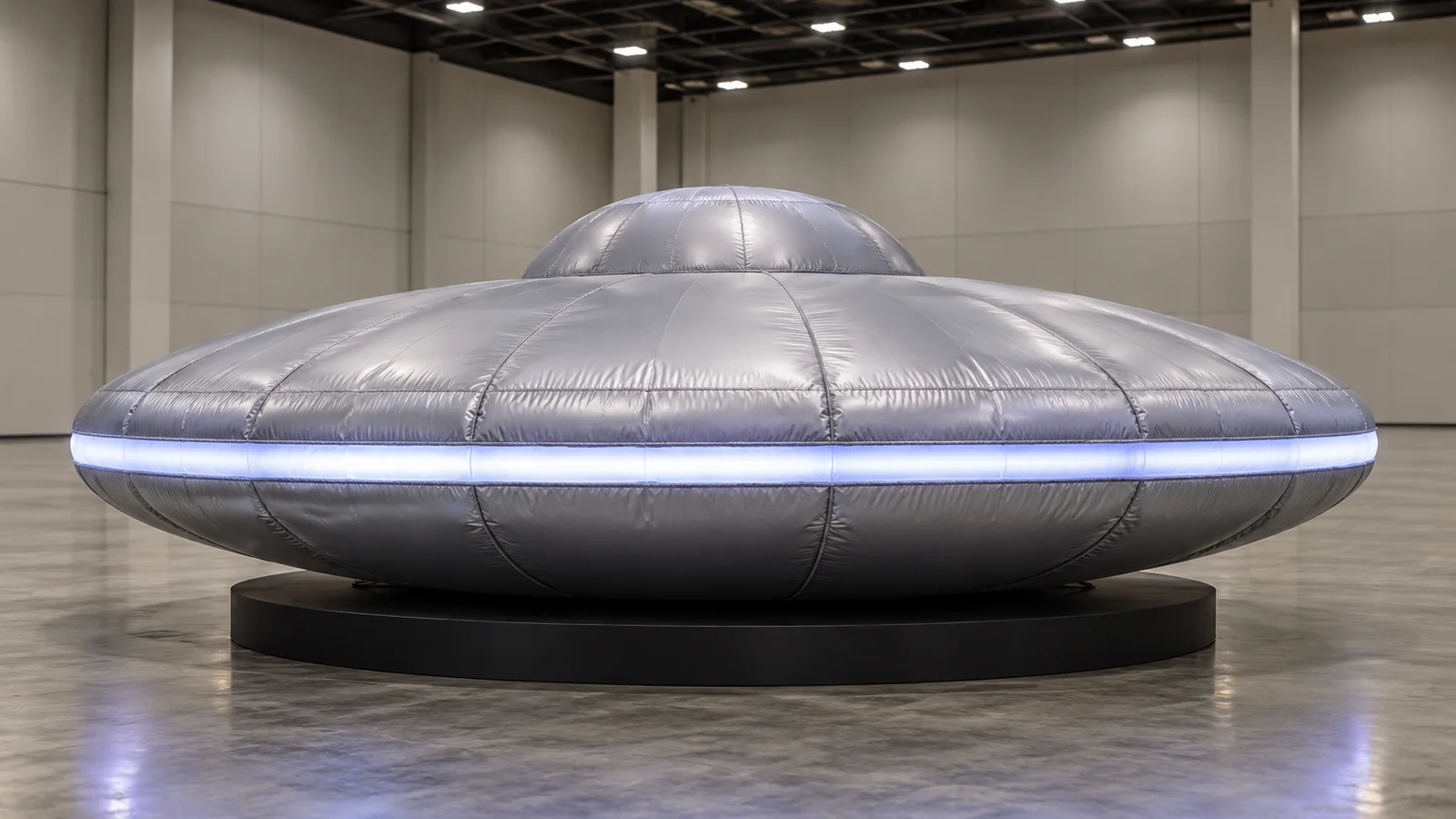
An effective lighting brief describes where the light appears, what the audience sees and how the effect will be checked. “A silver UFO with LEDs” leaves too much open: the supplier and event team may be imagining different surfaces, lighting zones and operating methods.
Before comparing prices, prepare one annotated reference image, a venue photograph and a short equipment brief. That small amount of preparation helps separate a visual concept from the product and services actually included in the quote.
1. Mark the illuminated areas
Divide the concept into the dome, rim, underside and any window-like details. Mark each area as illuminated, opaque or undecided. Use arrows or colored outlines on the artwork rather than asking the supplier to interpret a dramatic reference photograph.
| Visual intention | Question to resolve |
|---|---|
| A glowing body | Which panels should transmit light, and what should remain readable when the lights are off? |
| A bright rim | Is the intended effect a lit edge, distinct points of light or a wider glowing band? |
| Illuminated windows | Are these printed features, translucent areas or separately specified lighting elements? |
| A metallic appearance | Which surfaces need that appearance, and where is light transmission required? |
| Several effects in one prop | Are the zones meant to operate together or independently? |
The table is a briefing tool, not a list of standard options. Ask the supplier to explain the proposed construction and to identify any effect that cannot be reproduced in the selected build.
2. Show the real viewing conditions
Record the main audience viewpoint and the distance from which the outline needs to be recognized. Add the camera viewpoint if the installation will appear in a webcast, campaign video or press photography.
Use a photograph taken with the venue’s normal lights on. Identify nearby screens, decorative lighting or stage fixtures that will remain in use. Ask the supplier how the proposed effect will be reviewed under conditions relevant to the project, rather than accepting only a dark-room photograph.
A phone video is useful for discussing the look, but automatic exposure can change the apparent brightness and color. It should not be treated as a calibrated measurement. If objective performance requirements matter, agree the measurement and acceptance method with the relevant technical specialists.
3. Separate the effect from the controller
A request for blue light is different from a request for timed color changes. A local remote is different from a connection to the production team’s lighting desk. Write the desired behavior first, then ask for the proposed equipment and operating method.
Include these questions in the quote review:
- Is the effect steady, manually changed or linked to a show sequence?
- Are lighting zones controlled together or separately?
- What controller, power supply and connections are included?
- If a protocol such as DMX is required, what exact compatibility is being offered?
- Who is responsible for programming, integration and operation at the venue?
Do not interpret “RGB,” “remote control” or “LED included” as a promise of show-control compatibility. Functions and exclusions belong in the written scope.
4. Keep lighting and inflation requirements distinct
The display may need power for lighting, inflation equipment or both. Ask for a list of the equipment in the proposed build, its supply requirements and its intended location. Have the event contractor review the site connection and operating schedule.
If the concept depends on keeping an inflatable in shape after a venue closes, raise that issue before ordering. Do not assume a lighting connection remains live overnight or that a sealed-air configuration removes the need to review electrical equipment.
For the general structural distinction, see sealed-air versus continuous-air inflatables. The appropriate arrangement still depends on the actual UFO design.
5. Agree what evidence will be reviewed
Before production, approve the annotated layout, agreed dimensions, lighting equipment scope and the intended installation arrangement. Before dispatch, agree which photographs or video checks are included in the order.
For a lighting-focused review, request views of the complete display with lights off and on, the main audience angle and any separately controlled zones. Ask for the accessories to be identified against the packing list. If multiple modes are included, agree how each will be demonstrated.
Check the evidence against the approved scope. A video of a similar product can help explain a concept, but it does not show that your actual unit has the same construction, control functions or accessories. Visual review also does not replace electrical checks, structural assessment or venue approval where those are required.
6. Compare quotations on the same basis
Ask each supplier to state what the quotation covers: body, lighting, inflation equipment, controller, accessories, packing and delivery scope. Keep local support structures, venue services and installation labor visible as separate responsibilities.
A lower price is difficult to assess if one proposal includes only a decorative body while another includes equipment and project-specific documentation. Resolve those differences before negotiating the total.
A concise brief you can copy
Describe the event and the intended role of the UFO. Give the target diameter and overall height, quantity, destination and required delivery date. Attach the reference image with the illuminated areas marked. Add the main viewing angle, a venue photograph, preferred colors, desired control behavior and any equipment interface requirement. State whether placement is on the floor or proposed overhead, who manages installation and which documents the venue requests.
If a detail is undecided, identify it as a design question. It is more useful to ask for an explained recommendation than to choose an unsupported specification from another supplier’s listing.
Quick buyer checklist
Related project resources
- Custom LED inflatable UFO project review
- Finland exhibition and event planning
- Inflation methods overview
Frequently asked questions
Is a picture enough to specify the lighting?
A picture communicates the visual direction, but it rarely identifies the equipment, illuminated zones or control method. Add annotations and a description of how the effect should operate.
Should I request a lighting sample?
Ask whether a material or lighting demonstration would resolve a specific uncertainty, such as how a printed panel looks when illuminated. Confirm sample scope, cost and timing before relying on it; do not assume a small sample represents the complete display.
Can a lighting test approve an overhead installation?
No. Lighting review and installation approval address different questions. An overhead proposal needs the product information, support design and venue review appropriate to that installation.
Turn the concept into a quote-ready project
Send your annotated reference, approximate size, quantity, venue details, destination and required date for project review.
Send Quote Request