Brand Activation Planning · · Updated
Custom Inflatable Bottle vs Can for Beverage Sampling: B2B Buyer Guide
For a beverage sampling activation, choose a custom inflatable bottle when the original package's cap, neck or shoulders are the strongest recognition cue; choose a can when its cylindrical silhouette and wraparound label are the hero. Neither shape makes the installation automatically suitable for a venue. First confirm who needs to recognize the product, where guests will queue, the usable footprint and how the display will be operated. This guide helps brand managers, experiential agencies and distributors in the US, Canada, Europe and Australia compare design and procurement scope before requesting a project-specific quotation.
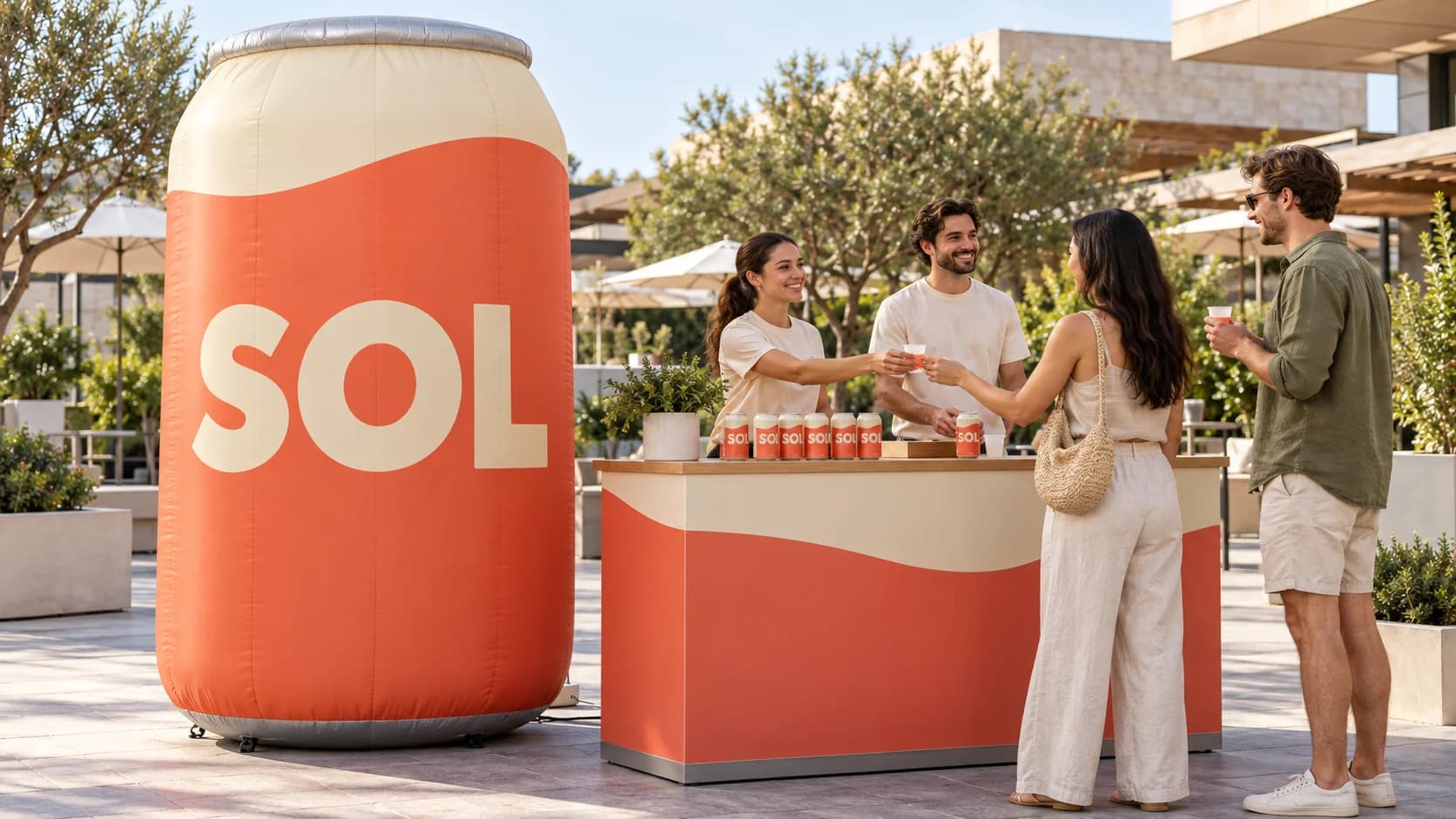
Decide what the replica must do before deciding its height
A successful sampling prop has a specific job. From the entrance to the activation it should help visitors recognize the beverage; next to the service counter it should connect that product to the sample actually offered. A large shape that hides the counter or forces staff to work around cables can undermine the purpose of the campaign even if it looks impressive in a render.
Write one sentence describing the intended outcome: for example, 'Make the new can recognizable from the aisle while preserving an open serving counter,' or 'Create a bottle-shaped photo landmark separate from the queue.' Then identify the main viewing direction and a secondary viewing direction. Use a venue photograph with a person or counter for scale rather than selecting an arbitrary giant height.
Include the operator's responsibilities in the brief. A display for a one-day store launch is not the same procurement problem as a prop that must be packed, transported and set up by different teams over a multi-city roadshow.
Bottle or can? Compare silhouette, graphics and practical space
Bottle: a distinctive shoulder, neck, lid or pump shape may carry the brand identity even when the printed label is partly obscured. The trade-off is geometry. A narrow neck, pronounced shoulder or sculpted cap can require additional pattern pieces and a careful review of how seams, inflation and material tension affect the intended shape. Small molded packaging details may need simplifying at display scale.
Can: a more regular cylindrical form offers a broad curved label area that may be easier to read around a sampling counter. The trade-off is that similar cylindrical shapes can become interchangeable if the artwork is weak. Check the rim, top, color blocks and key mark from the real approach path, and review how the label's left and right edges meet on the inflated surface.
Compare both candidates at the same visual height and within the same site footprint. Use original packaging photographs and a dimensioned sketch, not merely a front-facing mockup. The supplier should review whether the requested shape, base and print detail are feasible at the chosen scale. This is a decision framework, not a claim that one type is always cheaper, faster or safer.
- Bottle is often a better concept to test if the actual container's shoulders, cap or neck are highly distinctive.
- Can is worth testing when large, legible 360-degree graphics and a simple package silhouette are the dominant brand cues.
- Choose neither until the venue can accommodate the installed depth, safe access, support system and operating plan.
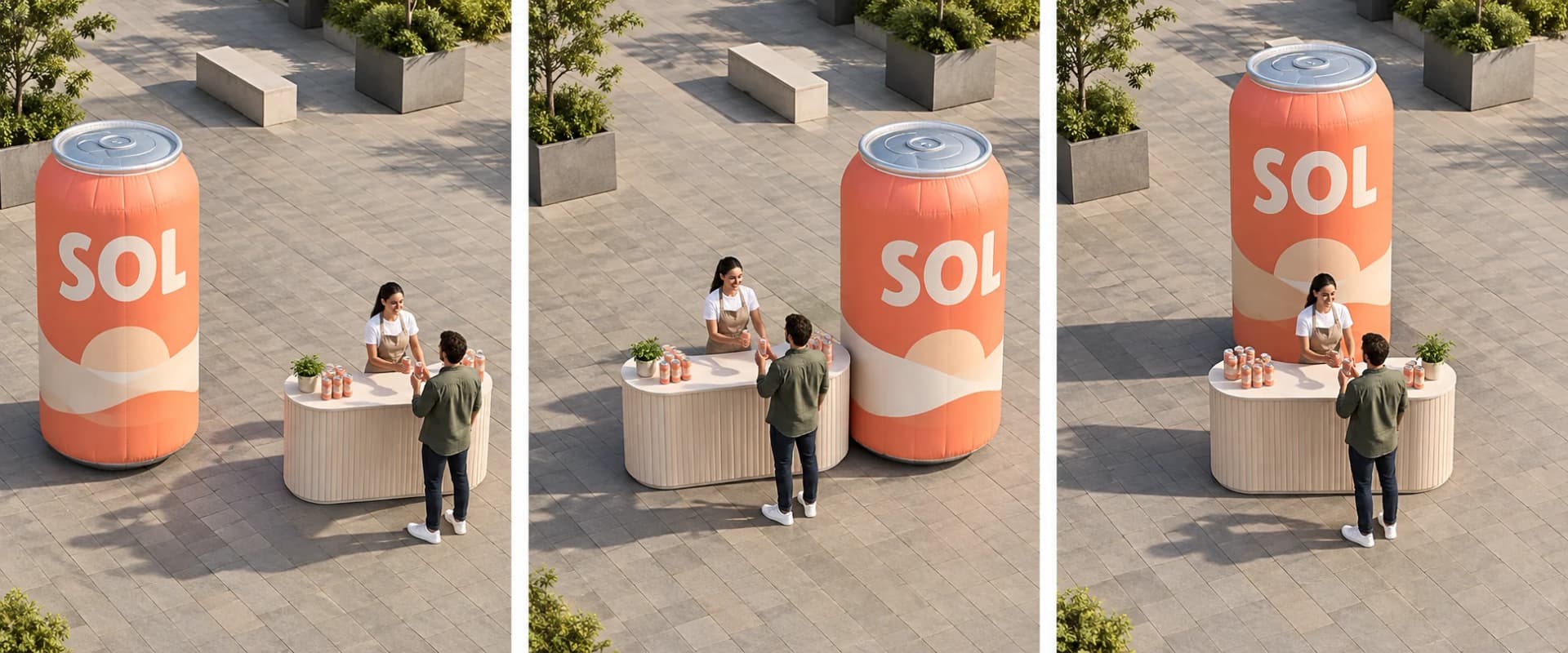
Compare three sampling layouts on one floor plan
An independent landmark can announce the activation from farther away while leaving the service table uncluttered. It introduces a second location to supervise, however. Draw the intended route from landmark to sample pickup and verify that people stopping for photographs do not cross the working queue or occupy another exhibitor's space.
A counter-side replica keeps the visible package beside the sample. That can make the product association clearer but may block the cooler door, storage hatch, staff entry or the first guest in line. Specify whether it is on the left or right of the counter after you have identified the entrance, stock route and primary logo orientation.
A backdrop position may preserve the front and side of the counter, particularly within a booth. But staff, menu boards and tables can hide the important graphics. Test a sightline from a standing visitor rather than approving an empty 3D scene. In each option draw the inflatable's full installed footprint, not simply its apparent base.
Review the same visitor arrival, sample collection, photograph and departure sequence with all three layouts. The final choice should be approved by the activation manager and the local venue, not inferred from the image alone.
Protect guest flow, replenishment and photo areas
Map arrival, queue entry, flavor selection, sample handoff and exit. Add a realistic group of visitors and at least one replenishment trip on the plan. If a trolley must pass through the queue or staff need to reach a cooler behind the inflatable, revise the layout before the structure is made. Reserve room for waste removal and any accessibility requirements communicated by the venue.
Changeable promotions, legal sampling notices and flavor menus are generally easier to handle on separate counter signage than permanently printed on a reusable inflatable. The inflatable should represent authorized product packaging or an agreed campaign concept; do not put time-sensitive claims onto the replica merely to fill a print area.
For public events, the venue or event organiser must confirm circulation, emergency access and crowd-management provisions. A concept image is not a site-safety approval. The UK Health and Safety Executive's event crowd-management guidance is a useful starting reference for organising people and routes, but local rules still govern each site.
Prepare brand artwork for a three-dimensional print proof
Send the original package, photographs of the front, back, sides and top, and its measured height, width and important contour positions. Add approved vector logos, label dielines where available, brand color references, and permission to reproduce the marks. Identify the SKU or flavor that will be sampled so the replica and the serving counter tell the same story.
Ask for a dimensioned visual showing front, side and back views plus the likely seam and closure positions. A flat dieline can distort once wrapped around an inflated curved surface. Agree which fine text, highlights, cap ridges and edge details may need to be enlarged, simplified or omitted. Treat screen RGB previews as design references rather than proof of a certified color match.
For a photo-led campaign, place a human silhouette and the sampling table into the artwork proof. Check the hero logo from the intended camera angle and a vertical phone crop. If lighting is proposed, review day and evening appearances separately, along with power and maintenance scope.
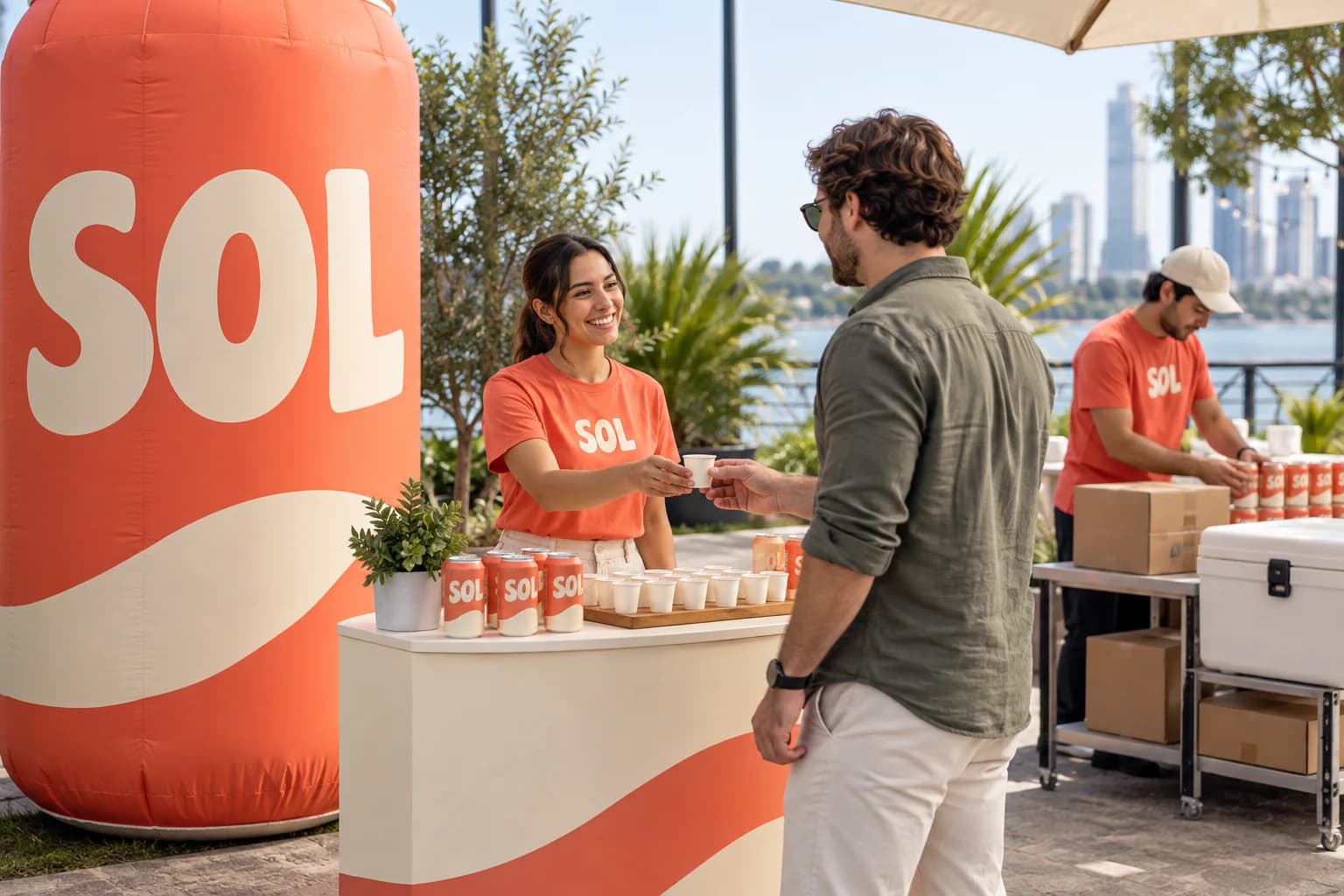
Choose an inflation method around how the team will operate it
A continuous-air design uses a running blower during display. Evaluate available power, blower location, noise at the service counter, cable protection, overnight operation and shutdown procedure. A sealed-air design is inflated and closed, but its practical air retention, seam treatment, valve arrangement and maintenance needs depend on the particular form. Neither is automatically the correct choice for a given bottle or can size.
Ask the supplier to propose the inflation method in writing and explain the operating implications for the actual venue. The quote should specify the blower or pump model if included, voltage and frequency, plug type, quantity of inflation devices, spare and repair items, and whether access to any equipment is required while guests are present.
A multi-country roadshow also needs local electrical review at every stop. Plug adapters do not make incompatible voltage or frequency safe. The competent venue team should approve power provision, cable routes and safe operating arrangements for each location.
Separate material documents from venue approval
Before ordering, request the event organiser's actual requirements for fabric and print treatments, electrical equipment, rigging or suspension, footprint, ballast and public access. Send those requirements to the supplier for the selected configuration. A generic claim that every advertising inflatable is 'CE-certified' or universally fire-retardant is not an adequate substitute for the specific documents a venue requests.
Outdoor placement needs a local assessment of wind exposure, changing weather, anchoring or weighting, surface type, supervision and a deflation decision. Do not reuse a wind-speed number from a different inflatable or another venue. For a proposed suspended display, use venue-approved rigging specialists and confirm attachment points and the allowed suspension load before approving the concept.
Clarify who supplies any evidence, who reviews it, and who makes the final on-site installation decision. It may be reasonable to pause the project while documentation is checked; do not invent a certificate, test result or universal event approval to make a deadline appear easier.
Plan a sampling tour around packing and repeat setup
For a campaign visiting several cities, ask about the packed dimensions and weights for the inflatable, pump or blower, cables, base and accessories. Record how many people will unpack, position, inspect and fold the asset and where it can be dried and stored between stops. Confirm whether spare parts, a repair kit, protective packaging or a storage bag are included rather than assuming them.
A reusable hero prop should have a stable artwork version and an asset identification record. If a different flavor is promoted at later stops, decide whether the brand team will accept the same hero pack, require changeable counter signage or commission separate approved graphics. Changing a photo backdrop or adding a new colorway may be simpler than reprinting an entire three-dimensional shell, but the supplier must review feasibility.
Before each event, the operating team should inspect seams, attachments, electrical equipment and accessories against the agreed setup instructions. Record damage and repairs between stops. A manufacturer's quotation cannot replace the local crew's inspection and venue permission.
Compare quotations on an equal scope, not just a headline price
Ask each bidder for the same approved artwork version, target installed dimensions and intended use. Compare shell and print details, inflation method, base and securement items, accessories, testing or inspection deliverables, packed size and weight, the production milestone plan, and the exact freight and local-installation responsibilities. Mark every option as included, excluded or pending confirmation. Two quotes are not comparable when one includes blower and packing while the other describes the fabric shell only.
Name the destination and delivery term. Under Incoterms 2020, FOB is a sea/inland-waterway rule and requires a named port of loading; for air or multimodal transport, discuss an appropriate term such as FCA with the exporter or forwarder. DAP or DDP may be explored only if the supplier confirms that the required responsibilities can actually be performed at the named destination. An Incoterm does not by itself fix the production deadline or payment schedule.
Use an itemised scope when evaluating a China-origin custom project against a domestic supplier or local rental. Factory production is only one part of total project cost. Packing, freight, customs, duties when applicable, event labour, storage, maintenance and return transport can materially change a touring campaign's economics. The requested terms should be explicit in the written quotation.
- Geometry: reference packaging, installed height/width/depth, approved seam and graphic locations.
- Construction: proposed material and printing, inflation method, pump/blower, repair and storage items.
- Site scope: support, ballast/anchoring or rigging plan, venue documentation and local crew duties.
- Freight: packed dimensions and weight, dispatch point, named trade term, destination and delivery planning assumptions.
- Approval: revision limits, who signs off artwork, and what proof is available before shipment.
Use a two-stage approval and handover checklist
Stage one is feasibility and design. Supply the exact packaging and site brief; receive an itemised concept describing the inflation type, dimensions, print areas, venue dependencies and items requiring confirmation. Resolve trademark permissions, layout conflicts and documentation gaps before treating the design as approved.
Stage two is production release and dispatch. Preserve the signed-off mockup and revision identifier. Confirm what material or print evidence, inflated-view photographs or video, accessory photographs and packing details will be provided for the actual unit. If a physical color sample or formal test is required, agree its availability, cost and schedule rather than presuming it is included.
Before the event, send the final product and accessory list, local operator responsibilities, installation instructions and approved venue details to the event manager. The delivered asset is not automatically a ready-to-operate public installation; acceptance on site remains a separate step.
B2B RFQ: copy this information into your enquiry
An effective initial enquiry does not need a polished presentation, but it needs enough detail to assess both fabrication and event feasibility. Indicate which items are confirmed and which still need supplier advice. If the project is confidential, use cleared sample artwork to begin and agree the handling of production files with the supplier.
For agencies, distinguish the end customer's brand approval owner from the agency's procurement contact and the venue's on-site decision maker. For importers and distributors, state whether the display will be sold as a single project or supported through repeat orders, replacement parts and multiple destinations.
- Buyer company and role; authorised brand or agency contact and final artwork approver.
- Product/SKU, bottle or can reference images, existing packaging dimensions and editable logo or label files.
- Preferred replica shape, target installed height/width/depth, quantity and main viewing distance.
- Site city/country, floor plan, photos and indoor/outdoor or overhead placement requirements.
- Operating dates, daily hours, last acceptable arrival date and time needed for local setup.
- Sampling-table position, queue approach, staff access and stock replenishment route.
- Expected power access, voltage/frequency, noise constraints and inflation preference if any.
- Artwork review, print finish, lighting, reuse, packed dimensions, accessories and document needs.
- Proposed delivery term and named place or port, unloading/installation scope and responsible forwarder.
When another display method is a better fit
A rigid printed board or simple retail lightbox may be more practical than a large custom inflatable where the venue has very little depth, cannot allow a protected blower cable, prohibits the proposed installation or needs extremely fine package details. A local rental or modular pop-up kit may suit a one-day campaign without unique artwork requirements.
The buyer should choose the format that makes sampling work safely and makes the brand easy to recognise. Inflatable replication is useful when a genuinely recognisable three-dimensional package and packable event asset support the campaign; it is not the right answer to every brief.
Frequently asked questions
Should I order a giant inflatable bottle or a can for a sampling stand?
Choose by the original packaging's strongest visual cue and the available footprint. A bottle can emphasise a recognizable neck or cap; a can can present a broad curved label. Ask for both concepts at the same scale if the venue allows.
Can the inflatable show several flavors?
It can represent a master brand if approved by the brand team, while separate counter signage identifies the flavors being sampled. If a flavor-specific pack is essential, agree the SKU and label proof before production.
Does a sealed-air display need a running blower?
A suitable sealed-air configuration is designed to be inflated and closed rather than continuously supplied with air. The actual holding time, pumping, seams and maintenance must be reviewed for the proposed shape and operating period.
Are all custom bottle and can replicas CE-certified or approved for public events?
No universal certification or venue approval should be assumed. Supply the actual event or organiser's requirements and request only the documents available for the specified configuration; the venue retains its local approval process.
Can I order a single unit, and how quickly will it arrive?
One-unit requests can be reviewed, but feasibility, minimum order quantity, production and freight timing are project-specific. Provide the final artwork readiness, event date and destination for a written quotation.
What is the difference between FOB and DDP for an inflatable display?
FOB under Incoterms 2020 is a rule for sea/inland-waterway carriage at a named loading port; DDP is for delivery to a named destination with seller import responsibilities. Confirm with the seller and forwarder which term is actually workable for your shipment and what is excluded.
What is the most important information to send for a quote?
Provide authorized package images and artwork, physical product references, replica size, quantity, site and layout, event date, destination and requested freight scope. Add specific document and electrical requirements if the venue has them.
Request a project-specific bottle or can replica quote
Send InflatCustom your real package photographs, authorized label artwork, desired installed dimensions and quantity, sampling counter layout, venue city, event date and destination. Mark any artwork, venue documentation or freight terms not yet confirmed. Request a proposed inflation method, design review, accessory and packing scope, and an itemised quotation rather than a fixed promise.
Request a concept and quotation